

A subwoofer can be superbly engineered, beautifully finished and perfectly matched on paper, yet still sound woolly, thin or oddly boomy in the wrong part of a room. Learning how to position subwoofers is often the biggest step between simply hearing more bass and feeling a kick drum start and stop cleanly, or sensing the scale of a cinema soundtrack without one-note rumble.
Low frequencies are governed as much by the room as by the subwoofer itself. Walls, corners, openings, furniture and your listening position all affect what reaches your ears. There is no universal ‘best corner’, but there is a reliable way to find the right place for your system.
Why subwoofer placement changes everything
Bass waves are long. At 40Hz, a single wave is more than eight metres long, which means it interacts strongly with the dimensions of most living rooms and dedicated cinema spaces. As those waves reflect from boundaries, they can reinforce one another at certain frequencies and cancel at others. These room modes are why bass may seem overpowering on one seat, then almost disappear a metre away.
Putting a subwoofer close to a wall increases its output. Placing it in a corner increases it further because the sub is working alongside two walls and the floor. That extra efficiency can be useful, especially in a large room or with a modestly powered model. The trade-off is that corners also excite more room modes, so the result can become thick and uneven.
The goal is not the greatest quantity of bass. It is even, controlled bass at the main listening position, with a convincing handover to the main loudspeakers. For music, that means a double bass has pitch and texture rather than a soft bloom. For film, it means an on-screen impact arrives with force but does not linger over dialogue.
Start with the listening position
Before moving the subwoofer, consider where you sit. Avoid placing the principal seat hard against the rear wall if the room allows. This is commonly a bass-heavy location, and it makes calibration harder from the outset. Moving the sofa forward even 30 to 60cm can make a meaningful difference.
In a home cinema, keep the primary seats as symmetrical as practical relative to the front speakers and screen. In a two-channel room, establish the main speaker and listening triangle first. A subwoofer should support an already convincing stereo image, not compensate for loudspeakers that are poorly positioned.
Open-plan spaces require a little more patience. An opening to a kitchen, hallway or stairwell can reduce bass pressure at some frequencies while creating unexpected peaks elsewhere. Treat the actual listening area as the priority rather than assuming the room’s overall shape tells the whole story.
How to position subwoofers with one simple test
The most practical starting point is the subwoofer crawl. It sounds faintly undignified, but it is remarkably effective.
Place the subwoofer temporarily at your main listening position, roughly where your ears would be when seated. Play a familiar bass-heavy music track, a slow frequency sweep, or a repeated bass line from a film soundtrack. Then move around the perimeter of the room, listening at likely subwoofer locations - along the front wall, beside a front speaker, part way down a side wall and, if practical, near a rear wall.
You are listening for the places where bass sounds smooth, full and articulate. Do not choose the spot with the most bass. Choose the spot where individual notes remain distinct and the level changes least as the programme material moves through different low frequencies. Once you have identified two or three promising positions, put the subwoofer in each one and listen again from the seat.
This method reverses the usual arrangement: by putting the sub at the seat, you hear how the room behaves from potential subwoofer positions. It will not replace professional measurement, but it quickly rules out locations that are likely to frustrate you.
Sensible first positions to try
For most systems, begin with the subwoofer on the front wall, between the main loudspeakers or just outside either speaker. This often gives a coherent presentation and keeps cabling discreet. Avoid pushing it tightly into a corner at first. Leave a little breathing room where possible, particularly if the subwoofer has rear ports or controls.
If the front wall produces a strong peak at the seating position, try a side wall. A position around one-third of the way along the side wall can work exceptionally well, though it may be less convenient visually. In a dedicated cinema, rear-wall placement can also be effective, especially with two subs, but it needs proper checking because rear corners can be over-enthusiastic.
Do not be concerned if the best acoustic position is not the most obvious interior-design choice. A compact sealed subwoofer may integrate discreetly beside a cabinet, while a larger ported design may need more clearance. There is usually a practical compromise, but it should be made after listening rather than before.
Set crossover, phase and level after placement
Position comes first. Once the subwoofer is in a promising location, integrate it with the rest of the system.
For an AV receiver or processor, allow bass management to handle the crossover initially. An 80Hz crossover is a sound starting point for many home-cinema loudspeaker packages, but it is not a law. Compact satellite speakers may need 90Hz or 100Hz; capable floorstanders may blend more naturally at 60Hz or 70Hz. Follow the loudspeaker manufacturer’s guidance, then trust measured results and familiar listening.
In a two-channel system, crossover settings depend on the main speakers’ real in-room extension, not simply the lowest figure printed in a specification. A high-quality subwoofer can add useful control below 40Hz even when floorstanding speakers claim deep bass. Set the crossover too high, however, and voices or upper bass may become too easy to locate at the subwoofer’s position.
Phase control aligns the subwoofer’s output with the main speakers around the crossover region. Start at 0 degrees, then compare it with 180 degrees while playing music with a steady bass line. Use the setting that produces the strongest, cleanest and most even bass at the seat. Variable phase controls offer finer adjustment, while advanced AV processing can set delay with much greater precision.
Level deserves restraint. The subwoofer should make a system sound larger and more complete, not announce itself on every track. A common mistake is setting it for excitement during the first five minutes, then living with fatigued, swollen bass for months. Bring the level down until it seems almost too subtle, then make small upward adjustments. The right setting often reveals itself when you switch the sub off and suddenly miss the foundation it was providing.
One subwoofer or two?
A single well-positioned subwoofer can be excellent. It is often the right choice for a music-led system, a modest room, or a carefully chosen main seat. More bass units do not automatically mean more bass quality.
Two subwoofers are valuable because they can smooth the room’s response, not merely increase output. Placing them at different locations makes it less likely that both excite the same troublesome room mode. This can improve consistency across a sofa, which matters in family rooms and cinemas where several people are watching.
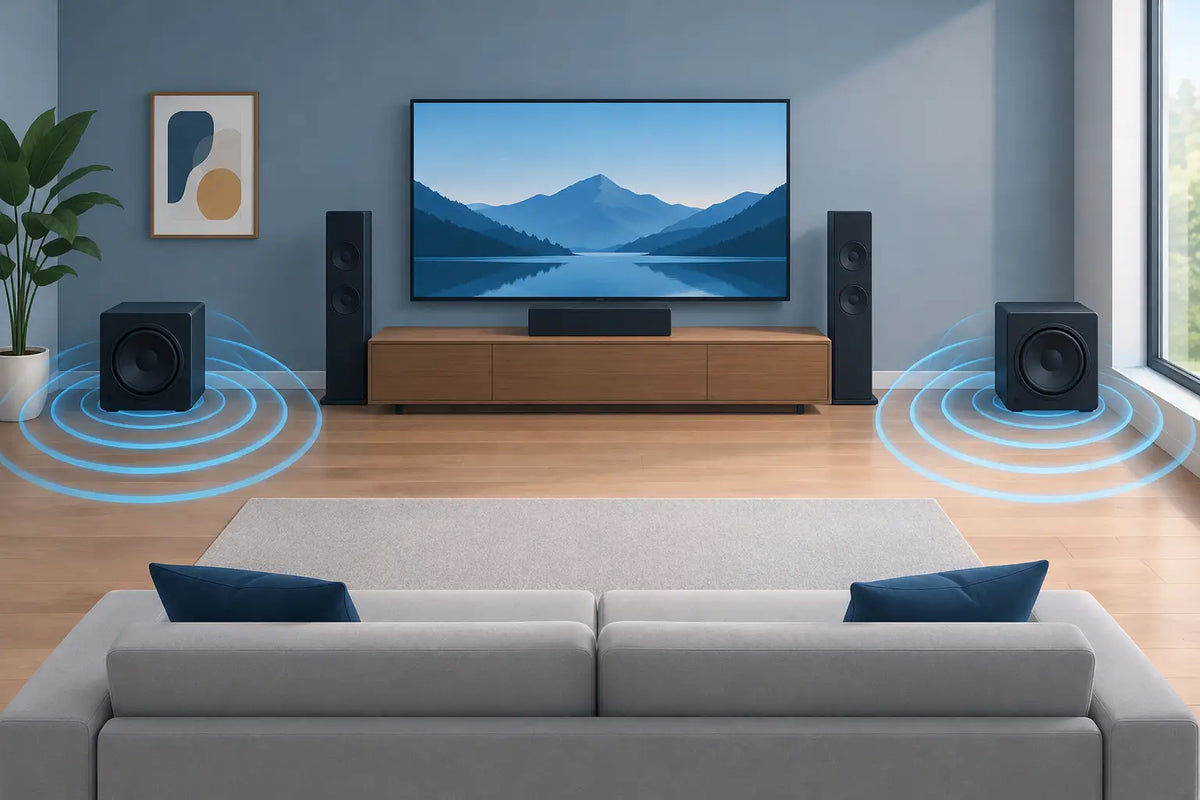
Common starting arrangements include one sub at the front and one at the rear, or subs positioned at the midpoints of opposing side walls. Symmetrical front-corner placement can deliver impressive output, but may not provide the smoothest response. The best arrangement depends on room dimensions, seating layout and the adjustment tools available.
Four distinct considerations make dual-sub systems more successful: use matching models where possible, set each unit to the same baseline level, measure from more than one seat, and give the processor or calibration system enough control over delay and equalisation. A premium AV processor with sophisticated bass management can be transformative here, but it cannot entirely correct a poor physical layout.
Use measurement without losing the pleasure
Your ears should have the final say, but measurements remove much of the guesswork. A calibrated measurement microphone and room-analysis software can reveal peaks and nulls that are difficult to identify with music alone. Many modern AV receivers include room correction, while higher-end systems may offer detailed optimisation for multiple subwoofers and seats.
Room correction is most effective when it refines sensible placement. It can reduce a broad peak, align timing and improve crossover integration. It cannot fill a deep cancellation completely, and aggressive equalisation may demand more from the subwoofer than is sensible. If a graph shows a major null, move the subwoofer, the listening position, or both before reaching for EQ.
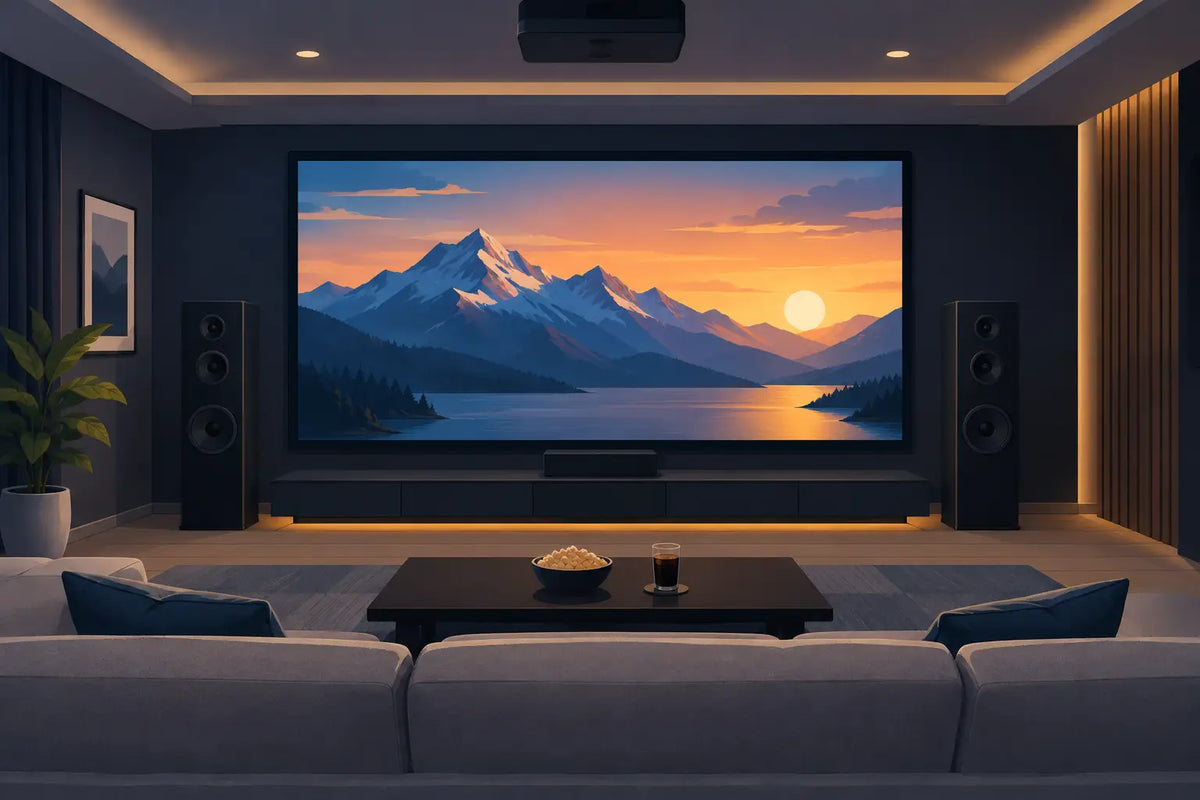
Acoustic treatment can also help, although true low-frequency absorption needs substantial depth and careful planning. In a purpose-built cinema, acoustic walls and professionally designed treatment can make bass response more even while improving the whole room’s clarity. In a living room, thoughtful placement, calibration and one or two subs usually offer the most meaningful gains without changing the character of the space.
Give the room the final vote
Use familiar recordings: a well-recorded acoustic bass, a tight electronic kick drum, a live concert and a favourite film sequence with demanding low-frequency effects. Listen at normal levels as well as spirited ones. If bass remains tuneful at low volume, stays controlled when the system is pushed, and feels evenly balanced from track to track, you are close.
A showroom audition can reveal what a capable subwoofer brings to a properly calibrated system, but your room always has the final vote. Take time with placement before changing equipment. A few carefully chosen positions, followed by measured calibration where available, can make a fine system feel startlingly more intimate, effortless and cinematic.

Share: