
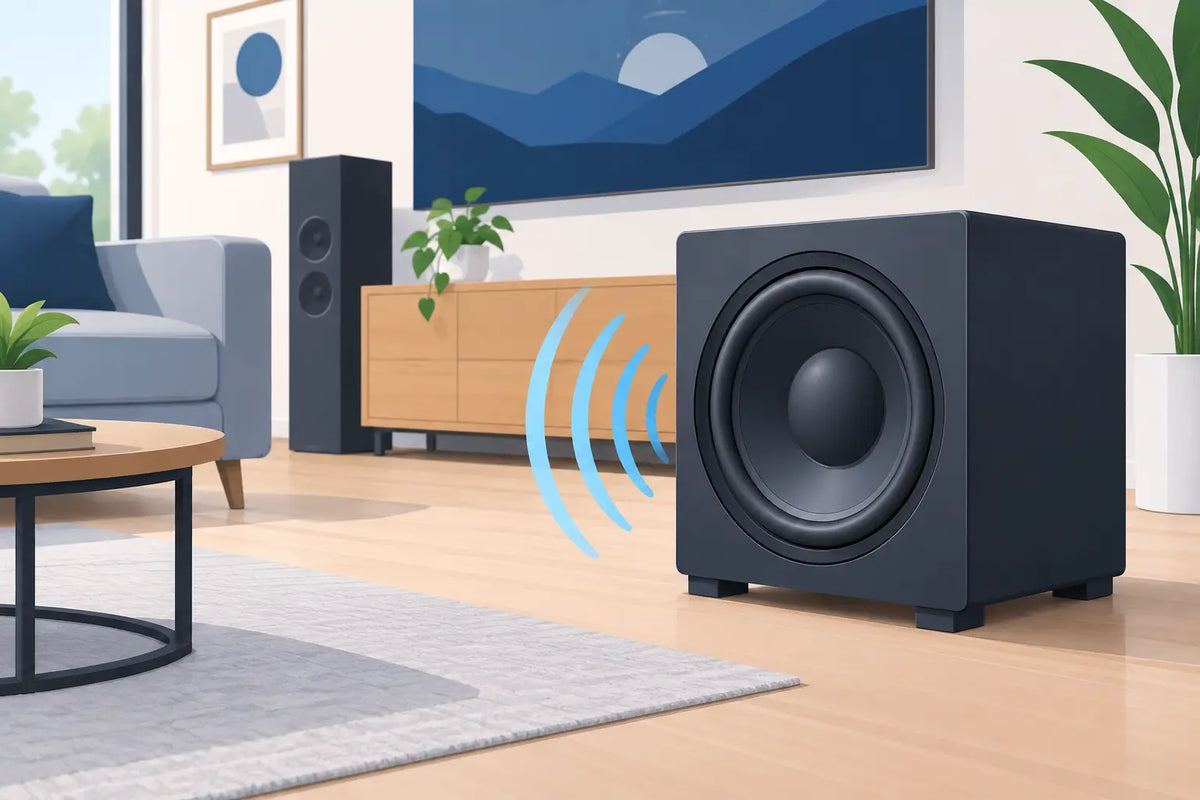
A good subwoofer should not announce itself with a one-note thump. It should make a double bass sound woody and resonant, let a kick drum start and stop cleanly, and reveal the lowest pedal notes of an organ without clouding everything above them. That is why choosing the best subwoofer for music is less about buying the biggest cabinet or chasing the deepest published number, and more about control, integration and suitability for your room.
Check out our range of Subwoofers here.
For serious two-channel listening, the right subwoofer can transform a system. Small standmount speakers gain scale without losing their agility; floorstanders sound less strained at realistic levels; recordings acquire the sense of venue and foundation that makes a performance feel present. Get the choice or setup wrong, however, and even an excellent hi-fi system can become slow, boomy and tiring.
Below is one our biggest sellers - the great sounding REL T/9X.

What makes the best subwoofer for music?
Musical bass is about timing, texture and evenness. A subwoofer for cinema is often asked to deliver spectacular effects at very high output. A music-led subwoofer has a different, though overlapping, task: it must blend invisibly with the main loudspeakers so that bass notes appear to come from the musicians, not from a box in the corner.
Look first at the quality of the driver, cabinet and amplifier rather than headline wattage alone. A well-engineered driver with generous excursion, a rigid enclosure and a properly controlled amplifier will usually sound more composed than a superficially more powerful alternative. Low distortion matters too. It is the difference between hearing the pitch and character of a bass guitar string and simply hearing more low-frequency energy.
Useful adjustment is equally valuable. Level, crossover frequency and phase controls are the essentials. More advanced models may add variable phase, parametric equalisation, app-based setup or room-correction facilities. These are not gimmicks when used properly: bass is shaped dramatically by the room, and adjustment gives the subwoofer a chance to work with that room rather than fighting it.
Sealed or ported: the choice that shapes the presentation
A sealed subwoofer uses an enclosed cabinet. Its air spring helps control driver movement, often producing a taut, articulate character that suits acoustic music, jazz, rock and finely recorded vocals particularly well. Sealed designs can be physically compact, but they may need more amplifier power and driver travel to reach very high levels or the deepest frequencies.
A ported, or reflex, subwoofer uses a tuned opening to extend output at low frequencies. Done well, it can deliver greater scale and efficiency, which is attractive in larger rooms and for listeners who want one system to serve both music and film. The trade-off is that a poor match, excessive output or an unsuitable port tuning can make bass sound less disciplined. This is not an automatic sealed-good, ported-bad decision. A carefully engineered ported model can be impressively musical, while a mediocre sealed design is still mediocre.
For predominantly two-channel listening in a modest to medium-sized room, sealed designs are often an excellent starting point. For an open-plan living space, larger floorstanders or a system that must reproduce concert-level dynamics and film soundtracks, a powerful ported option may make more sense.
Below is the new REL Planar PL1 subwoofer, which can be mounted on walls too.

Fast bass is not a specification
You will often see claims about a subwoofer being “fast”. Strictly speaking, bass speed is not a single measurable feature that one product possesses and another lacks. What listeners are hearing is usually good transient control, low distortion, sensible crossover setup and fewer room-induced peaks. The best test is familiar music with varied bass lines. Listen for whether individual notes remain distinct, whether kick drums have a clean leading edge, and whether the rhythm feels more compelling rather than merely heavier.
Match the subwoofer to your loudspeakers
The main loudspeakers set the context. Compact standmounts may begin to roll off around 50-70Hz, while substantial floorstanders can reach far lower. In either case, crossing over too high can make bass easier to locate and may thicken the lower midrange. Crossing over too low can leave a gap, or force smaller speakers to work harder than they should.
As a broad starting point, standmount speakers often work well with a crossover somewhere around 60-80Hz. Larger floorstanders may need a lower handover, perhaps 40-60Hz. These figures are only starting points, not rules. Speaker roll-off, room dimensions, subwoofer placement and listening position all alter the ideal setting.
Level matching requires restraint. Set the subwoofer so that it sounds slightly underwhelming on its own, then assess it with the main speakers playing. If you consistently notice the subwoofer, reduce the level or reconsider the crossover. The goal is not to hear more bass on every recording. It is to hear a more complete, more believable version of the recording.
A high-quality system may also benefit from high-level connection or carefully considered line-level integration, depending on the amplifier and subwoofer. High-level connections can allow the subwoofer to receive a signal with a similar sonic character to that feeding the speakers. Line-level connection is often more flexible, particularly with pre-outs, streaming amplifiers and processors. The correct approach depends on the equipment involved, so it is worth discussing before buying cables or committing to an installation.
Your room has the final say
Below roughly 100Hz, room behaviour becomes a major part of what you hear. Certain notes may swell dramatically while others almost disappear at the listening seat. Moving a subwoofer by as little as 30cm can make a greater difference than changing many component specifications.
Corner placement usually adds output, but it can also exaggerate particular frequencies. Placing the subwoofer along the front wall, near one of the main speakers, is a sensible first experiment for music systems because it can make integration feel more natural. Yet there is no universally perfect location. A practical technique is to place the subwoofer temporarily at the listening position, play a bass-rich track or test tones, and walk around the room. Locations where the bass sounds smooth and even are promising positions for the subwoofer.
Avoid judging placement with one spectacular electronic track alone. Use an acoustic bass recording, a well-recorded kick drum, piano in the lower register and a track with sustained low notes. You are listening for consistency across different notes and genres, not maximum drama on one favourite track.
Why two subwoofers can be a better upgrade than one larger unit
A second matching subwoofer is not simply about playing louder. Positioned thoughtfully, a pair can smooth room modes and give more even bass across the sofa rather than one privileged chair. Stereo placement can also preserve the spatial relationship between left and right channels when the crossover point is relatively high.
This does not mean every music system needs two subwoofers. In a smaller room with one main listening position, a single excellent model, correctly placed and calibrated, can be superb. In a wide room, an open-plan space or a family room with several listeners, two smaller subs often represent the more refined solution.
Do not overlook calibration and room treatment
- Audio Calibration by Yorkshire AV
DSP and automatic room correction can be extremely helpful, especially for reducing dominant peaks. They cannot fully repair a deep cancellation caused by the room, and they cannot make poor placement ideal. Start with placement, crossover, phase and level, then use calibration to refine the result.
Acoustic treatment also has a role, though bass control requires substantial, carefully positioned absorption rather than thin decorative panels. In a dedicated listening room or cinema, proper acoustic planning can improve clarity and consistency throughout the system. It is one reason a demonstration in a properly set-up room reveals far more than a quick comparison based on specifications.
Audition with music you know intimately
The best subwoofer for music is the one that disappears into your system and your room. Take a few tracks you know almost by heart: a live recording with a convincing venue acoustic, a favourite vinyl pressing, a busy bass line and something sparse enough to expose timing. Listen at realistic volume, then lower volume too. Good integration remains believable when the system is not being pushed.
At Yorkshire AV, an audition can put these decisions into context: different subwoofer designs, loudspeaker pairings and room setups reveal why a seemingly small adjustment can change the entire presentation. Fancy a demo? No problem.
When the setup is right, you will not spend your evening thinking about subwoofers. You will simply notice that a singer sounds more grounded, a rhythm section has greater purpose, and your favourite records have found the missing octave they always deserved.
Share:
Part Exchange Hi-Fi Equipment With Confidence