
Check out our Clearance Section, which has our part exchanged equipment listings.
That cherished amplifier has given years of pleasure, but a new streamer, better loudspeakers or a more capable home-cinema processor is calling. The question is not simply what to buy next. It is how to move your existing system on sensibly, without the uncertainty of private listings, no-shows and guesswork over condition. To part exchange hi-fi equipment is often the most straightforward route from a system you know well to one that brings more of the recording, film soundtrack or live performance into your room.
For many music lovers, part exchange is also a practical way to keep a carefully assembled system moving forward. It turns quality equipment into useful credit towards a meaningful upgrade, while placing pre-loved components with a specialist who understands what they are, how they should perform and where they sit in the market.
Why part exchange makes sense for serious hi-fi
A private sale may occasionally achieve a higher headline figure, particularly for a sought-after, immaculate component. It also asks you to research realistic pricing, photograph the item, field messages, pack it safely and manage payment and collection. That can be worthwhile if time is on your side and you are comfortable selling technical equipment yourself.
Part exchange prioritises certainty and convenience. A specialist can assess the equipment, agree a value and apply it directly to your next purchase. There is no need to find a buyer for a pair of heavy floorstanders before you can order their replacement, or to leave a gap in the rack while you wait for an auction to end.
The value is not just financial. A good dealer will consider the whole system. A more powerful amplifier is not automatically an upgrade if it does not suit your loudspeakers, room or listening habits. Equally, replacing a perfectly capable DAC may make less difference than improving speaker positioning, adding room treatment or moving to loudspeakers with better bass control.
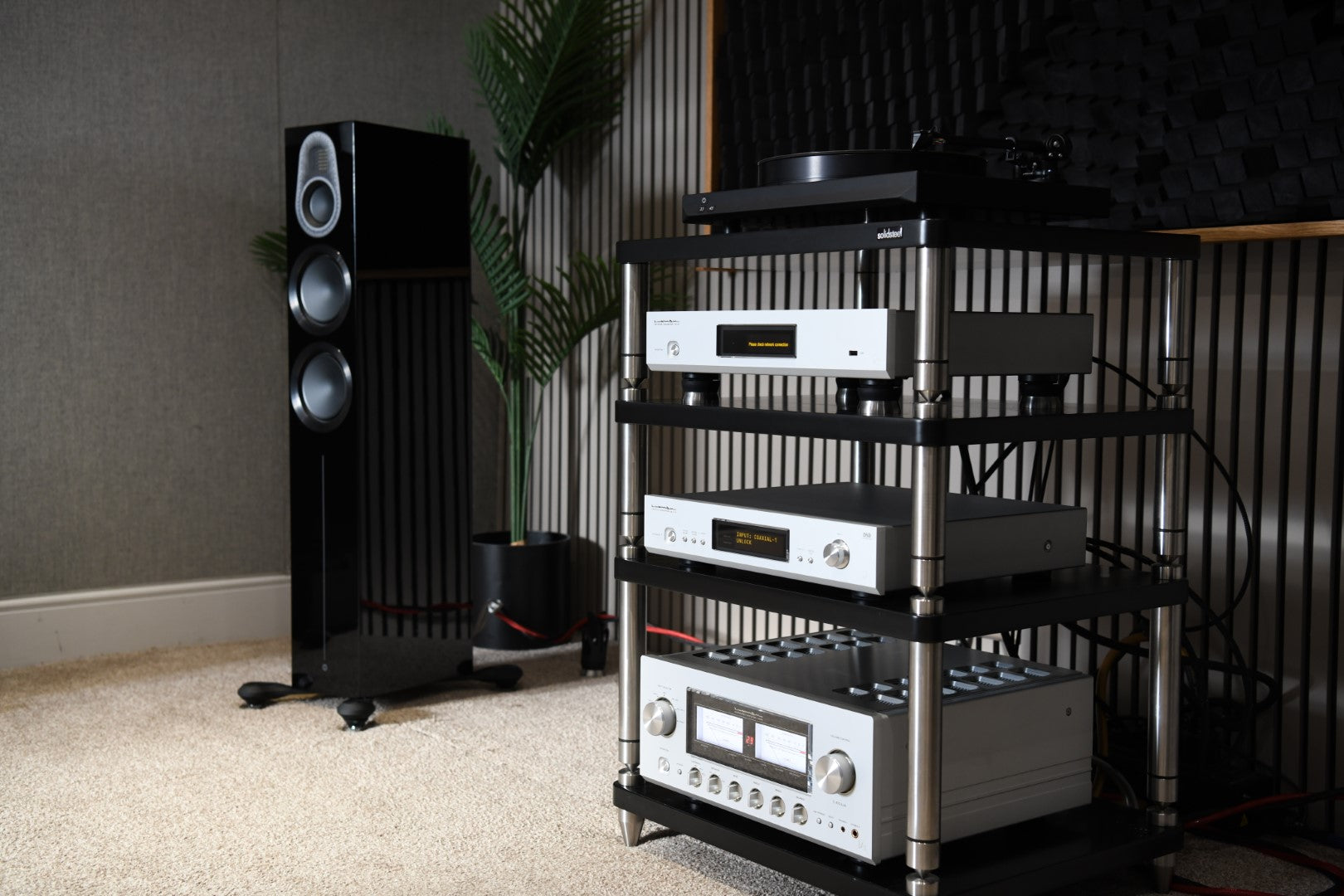
Below are some stunning Monitor Audio Platinum 300 - available at a great price!

How part exchange hi-fi equipment is valued
There is no universal percentage of original retail price. Values reflect what an item is worth now, not what it cost when new. Premium hi-fi from respected brands tends to hold its appeal because build quality, serviceability and sound performance endure, but demand varies by product type and model.
A current integrated amplifier from a well-supported manufacturer may be highly desirable. A discontinued AV receiver can depreciate more quickly as HDMI standards, video formats and room-correction platforms evolve. Turntables, phono stages and analogue amplifiers often remain attractive for longer, provided they have been cared for. Loudspeakers can retain strong value too, although their condition and the challenge of transporting them matter greatly.
A realistic valuation usually takes account of age, cosmetic condition, operational condition, original accessories, packaging and prevailing demand. Remote controls, power supplies, calibration microphones, speaker grilles, transit screws and proprietary cables are more significant than they may seem. Missing items do not necessarily prevent a part exchange, but they can affect the offer.
Service history helps, especially with older or reference-level equipment. A recently serviced valve amplifier, for example, gives useful reassurance when accompanied by supporting paperwork. With a turntable, the condition and age of the cartridge should be discussed separately: cartridges are wear items, and their remaining life has a direct bearing on value.
Below are some stunning Dali Rubicon 6 we have just taken in as part exchange

Condition means more than a clean fascia
A few honest photographs are the fastest way to begin. Include the front, rear connections, top panel, sides and any visible marks. Photograph serial-number labels where requested, along with accessories and boxes. Be clear about faults, intermittent issues or repairs. A volume control that crackles occasionally, a streamer that drops its network connection or a loudspeaker with cabinet damage needs to be known from the outset.
This is not about making an item look worse than it is. It is about arriving at a fair figure that holds up once the equipment is inspected. Specialist equipment is assessed beyond appearance. Inputs and outputs should work correctly, network functions should connect reliably, displays should be legible, and mechanical parts such as CD transports, tonearms and motor assemblies should operate as intended.
Before requesting a valuation, it is worth checking four simple things:
- Locate the original box, internal packing, manuals and accessories.
- Note the exact model, finish, approximate purchase date and serial number.
- Test the inputs and functions you normally use, including the remote control.
- Remove personal settings, saved Wi-Fi details and streaming-service accounts from connected products.
Do not attempt a repair simply to improve the offer unless you have discussed it first. An incorrect replacement part or amateur intervention can create a larger problem than the original fault. The same applies to over-zealous cleaning. A soft cloth is sensible; aggressive polish around anodised finishes, speaker drive units or turntable bearings is not.
Put the exchange towards the upgrade that matters
The most satisfying part exchanges begin with a clear reason for changing the system. Perhaps voices feel boxed in during films, bass is exciting in one seat but boomy in another, or your vinyl collection deserves a quieter phono stage and a more revealing cartridge. Perhaps the family wants music in the kitchen and garden without making the main listening room harder to use.
These are different problems, and they call for different answers. If your current loudspeakers are the limitation, diverting the budget into a prestige amplifier may not bring the transformation you expect. If the room is large, open-plan or acoustically lively, speaker choice, placement and calibration can matter as much as electronics. In a dedicated cinema, AV processing, subwoofer integration and acoustic treatment may deliver a greater leap than changing the projector alone.
This is where a demonstration earns its place. Bring familiar music, ideally tracks you know down to the breath before a vocal phrase or the texture of a bass line. For cinema, use scenes that reveal dialogue clarity, dynamics and surround steering rather than relying on spectacle alone. Compare like for like, then listen to the complete system rather than chasing a single impressive specification.
At Yorkshire AV, an exchange can be part of that wider conversation. Listening rooms make it possible to hear how a change in amplification, speakers, streaming or room setup affects the experience before committing. Fancy a demo? No problem. The aim is not to replace equipment for its own sake, but to make the next system feel unmistakably more involving in your home.
When keeping your existing equipment is the better call
Part exchange is not always the right answer. A well-matched component that is performing faultlessly may deserve to stay, particularly if the proposed change solves no clear problem. Some older amplifiers have excellent power supplies and a character their owners genuinely prefer. Certain loudspeakers may work beautifully in a particular room even if a newer model has more fashionable features.
There is also a strong case for building around a trusted component. If you love your turntable, for example, a carefully chosen phono stage, cartridge and isolation solution can be more rewarding than replacing the deck wholesale. If you have invested in a substantial power amplifier, a better pre-amplifier, DAC or streamer could reveal its potential.
A specialist should be comfortable saying this. The right upgrade is not necessarily the most expensive one, nor the one with the longest feature list. It is the one that removes the limitation you hear or feel every time you sit down to listen or watch.
Practicalities: collection, packing and the handover
Large loudspeakers, heavy amplifiers and fragile turntables need proper handling. Original packaging is best because it was designed for the product, but alternatives can be arranged where appropriate. Never send a turntable with its platter, counterweight and cartridge unsecured. Remove or protect anything that can move in transit, and retain any transit bolts supplied by the manufacturer.
For installed systems, plan the changeover before disconnecting anything. Photograph the rear panels, label cables and make a note of network details or control settings. This is especially useful with multi-room systems, cinema processors and integrated control. A professional installation can be transferred methodically, then recalibrated around the new equipment rather than reduced to a tangle of unidentified leads.
The best time to part exchange is when you are ready to make a considered improvement, not simply when something new appears. Present the equipment honestly, use its value where it will have the greatest audible or visible effect, and give yourself the chance to hear the result properly. A familiar favourite played through a system that suddenly feels more open, composed and emotionally direct is a far better reason to change than a specification sheet alone.

Share:
How to Match Amplifier Speakers for Better Sound
Best Subwoofer for Music: How to Choose Well