
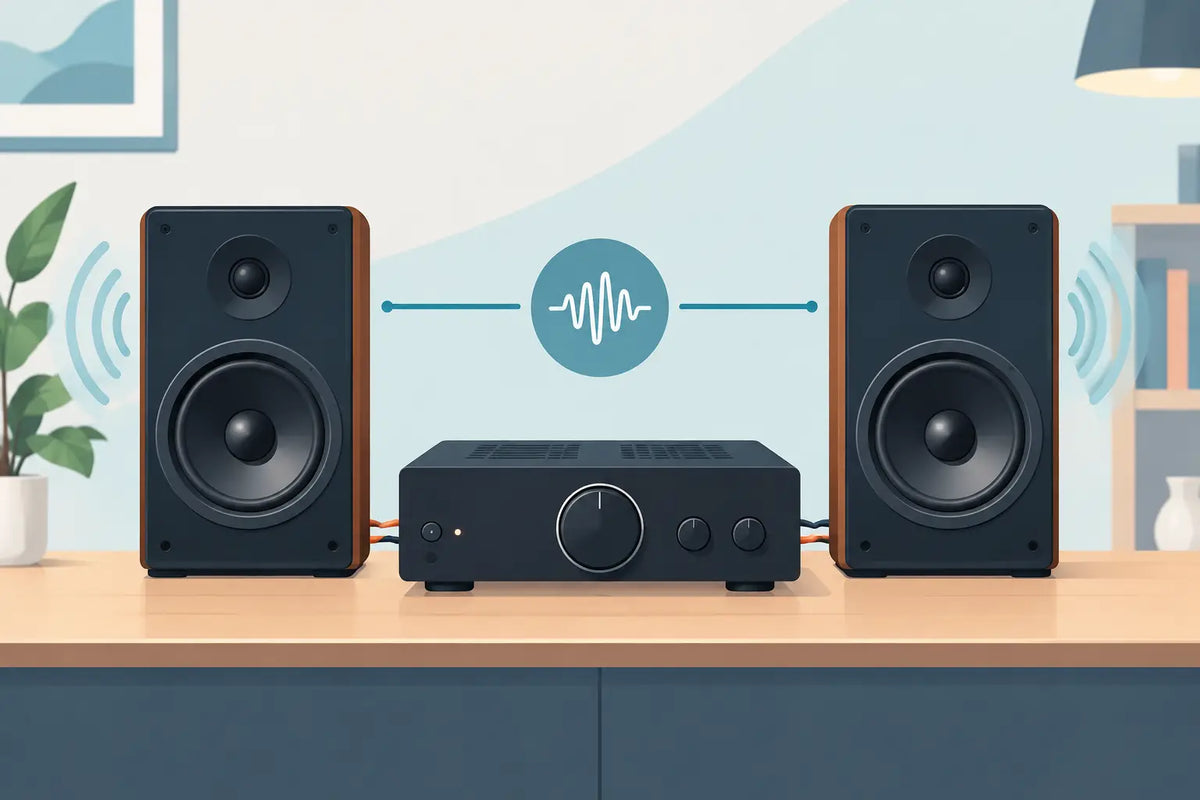
A system can look perfectly sensible on paper yet leave music sounding flat, strained or oddly lifeless. Learning how to match amplifier speakers is less about chasing the biggest wattage figure and more about ensuring your equipment works comfortably together in your room. Get that relationship right and you hear the benefits immediately: firmer bass, cleaner dynamics, a more believable soundstage and the sense that performers have stepped into the room.
The reassuring news is that most quality amplifiers and loudspeakers can be partnered safely. The finer decisions are about performance, not simply avoiding damage. Power, impedance, sensitivity, room size, listening distance and the character of each component all play a part.
Start with speaker impedance, not wattage
Impedance is the electrical load a loudspeaker presents to an amplifier, measured in ohms. You will commonly see speakers rated at 4, 6 or 8 ohms. A lower impedance asks more current from the amplifier, particularly when music becomes demanding at bass-heavy or dynamic moments.
An amplifier specified as stable into 4 ohms is usually a strong candidate for 4-ohm speakers, assuming its manufacturer’s guidance supports the pairing. That does not mean an 8-ohm-rated amplifier will automatically fail with a nominal 4-ohm speaker. Many well-designed integrated amplifiers handle such loads happily. The complication is that nominal impedance is an average description, not a complete picture. Some speakers dip substantially below their stated figure at certain frequencies, which can make them more challenging to control.
This is why an amplifier’s power rating alone can be misleading. Two amplifiers both quoted at 100 watts per channel may behave very differently when a speaker’s impedance falls. One may have a generous power supply and plenty of current reserve, retaining grip and composure. The other may become hard, compressed or protective when asked to play loudly.
For a straightforward two-channel system, check the recommended amplifier range in the speaker specifications, then confirm the amplifier is comfortable with that impedance. Treat the speaker maker’s range as a useful guide rather than a target you must hit exactly.
How to match amplifier speakers by power
Speaker specifications often give a recommended amplifier power range, perhaps 30 to 150 watts per channel. It is tempting to choose an amplifier at the bottom of that range to be safe. In practice, a clean, capable amplifier with sensible headroom is often the safer and more satisfying choice.
Music contains short, dramatic peaks. A drum strike, orchestral crescendo or sudden film effect can require significantly more power than the average listening level suggests. An underpowered amplifier driven beyond its limits can clip, producing distortion that is far more likely to damage tweeters than a more powerful amplifier used responsibly.
That does not give licence to turn a powerful amplifier fully up. Speaker damage can still result from excessive volume, especially with small standmounts or delicate drivers. The goal is controlled reserve: enough power that the amplifier is not gasping when the music opens up, while retaining sensible volume habits.
For many average UK lounges, a genuinely capable 50 to 100 watts per channel integrated amplifier is ample with moderately sensitive speakers. Larger rooms, low-sensitivity floorstanders, wide listening distances or a preference for realistic concert levels may justify more. Equally, highly efficient speakers can sound superb with modest-power amplification, including certain valve designs. Context matters more than headline numbers.
Sensitivity explains how loudly a speaker plays
Sensitivity, expressed in dB, indicates how loud a speaker plays from a given input. A speaker rated around 90dB is generally easier to drive to satisfying levels than one rated at 84dB, all else being equal. A difference of 3dB requires roughly twice the amplifier power for the same volume.
However, sensitivity cannot be viewed in isolation. A 90dB speaker with difficult impedance behaviour may still need an authoritative amplifier. Conversely, an 86dB speaker with a benign load can be an excellent match for a refined, moderately powered integrated model. Use sensitivity to form a picture, not to make the decision on its own.
Current and control matter when bass gets serious
The difference between loud and convincing is often control. A good amplifier should start and stop a bass driver cleanly, preserving the texture of a double bass, the attack of a kick drum and the weight of a cinematic soundtrack without turning the room into a blur of low-frequency energy.
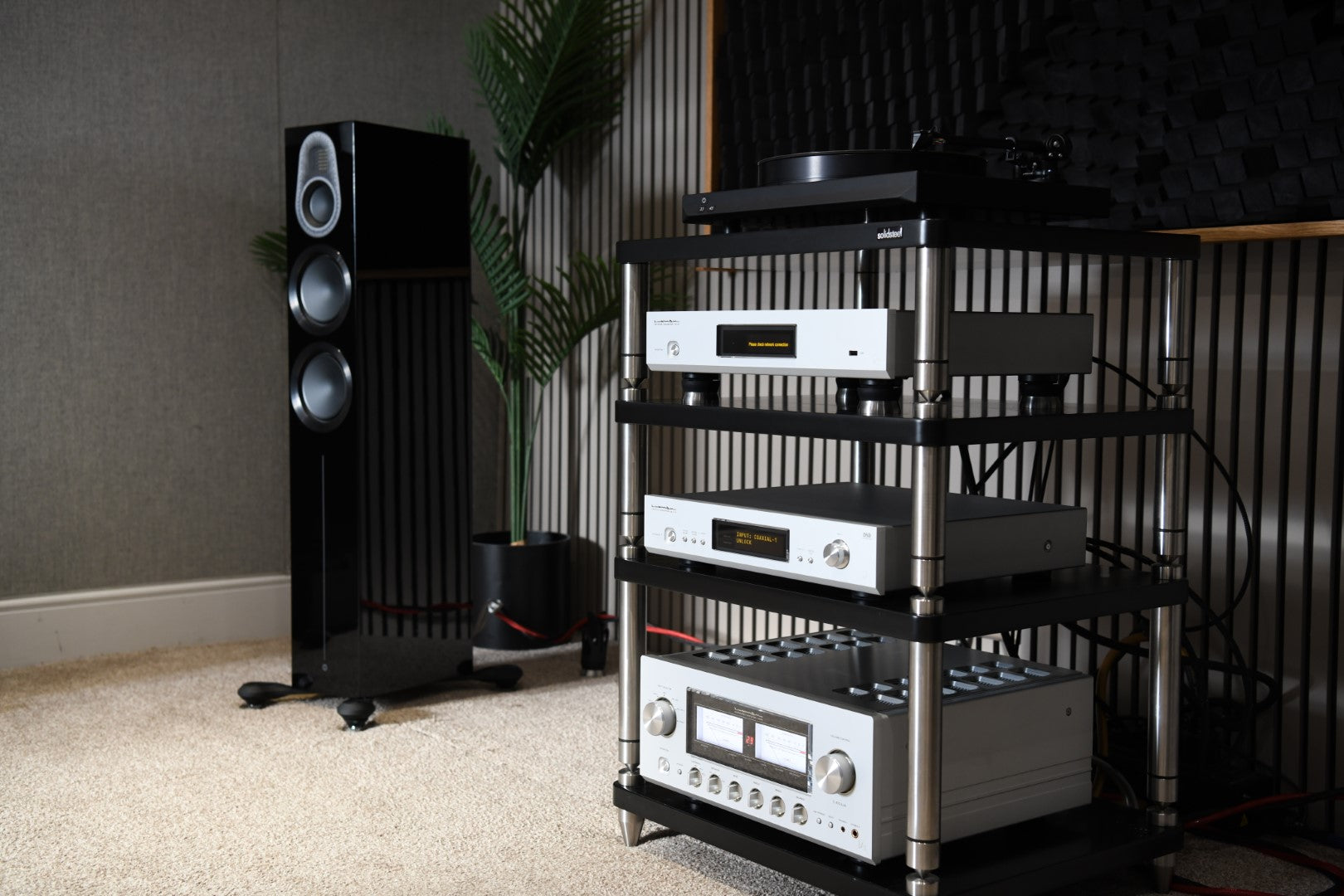
This is where amplifier current delivery and power-supply design matter. Premium amplifiers from brands such as Luxman, Lyngdorf and Roksan are not defined only by watts. Their engineering, load stability and ability to remain composed under pressure can make a more audible difference than a small numerical power advantage.
Large floorstanding speakers with multiple bass drivers tend to reveal this quickly. They may produce plenty of sound with a lightweight amplifier but lack authority, timing and scale. A more substantial partner can make the same speakers sound less effortful at ordinary levels, not merely louder.
Match the system to the room and listening habits
Your room is part of the system. A compact standmount speaker in a smaller lounge may offer more natural balance than an imposing floorstander forced close to corners. Conversely, a larger open-plan space can swallow bass energy and demand a speaker and amplifier combination with greater scale.
Think about where you sit, how far away the speakers are and what you play most often. If you listen to jazz, acoustic recordings and vocals at modest levels, tonal finesse and low-level detail may take priority over brute force. If electronic music, rock, big orchestral works or film soundtracks are regular favourites, dynamic headroom and bass control become more significant.
Placement has as much influence as component matching. Before changing equipment, give your speakers some breathing space from rear and side walls where possible, keep them stable, and experiment with toe-in. A pair moved by even a small amount can sharpen stereo imaging and reduce boomy bass.
Do not ignore the source component
A revealing amplifier and speaker pairing will only show what it is fed. A decent turntable correctly set up with an appropriate phono stage, or a capable streamer and DAC playing high-resolution audio, gives the amplifier a cleaner signal to work with. This does not mean every component must cost the same. It means avoiding a serious bottleneck at either end of the chain.
Cables should be sensibly specified, correctly terminated and of suitable gauge for the run length. They matter, but they should not take priority over getting the amplifier, speakers, room and source right first.
Stereo and home cinema need different thinking
With a stereo integrated amplifier, matching is usually a direct conversation between two channels of amplification and one pair of speakers. Home cinema adds more variables: a centre speaker, surrounds, height channels, subwoofers and an AV receiver or processor feeding several channels at once.
AV receiver power figures are frequently measured with one or two channels driven. When a demanding soundtrack energises many speakers simultaneously, available power per channel can reduce. For a modest 5.1 system in a normal room, a quality AV receiver may be entirely appropriate. For larger rooms, inefficient speakers or a cinema designed around high playback levels, external power amplification or separate processing can deliver more effortless results.
The front left, centre and right speakers deserve particular attention. Ideally they should share the same tonal family, so dialogue moves across the screen without changing character. A properly integrated subwoofer also eases the burden on the main speakers and amplifier, while bringing genuine low-frequency impact rather than simply more boom.
Listen for partnership, not just specifications
Specifications narrow the field, but they cannot tell you whether a system makes you want to play another album. Some speaker and amplifier combinations sound energetic and forward; others are smoother, richer or more expansive. Neither approach is automatically better. Your room, music collection and preferred listening level decide what feels right.
When auditioning, take familiar recordings with you. Listen for the clarity of vocal phrasing, the shape of bass notes, the space around instruments and how the system behaves when the track becomes busy. Turn it down as well as up. A well-matched system remains engaging at lower levels, rather than needing volume to come alive.
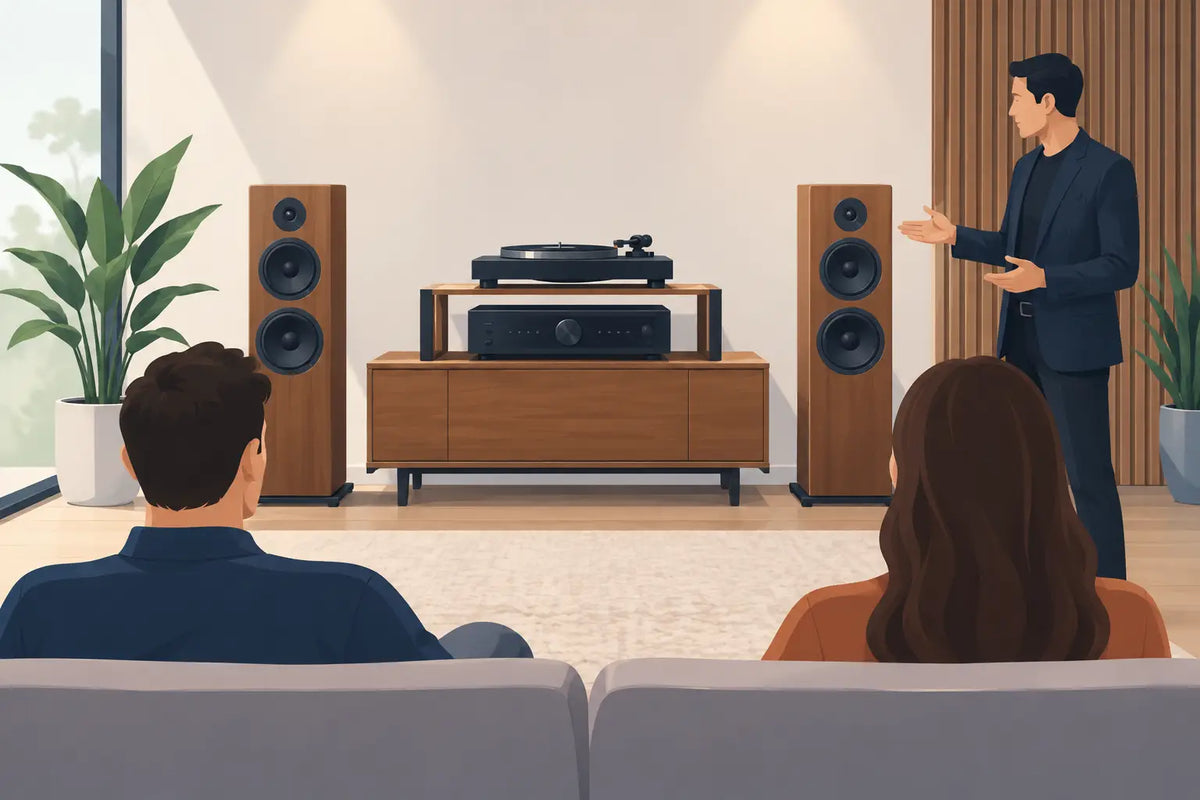
At Yorkshire AV, the value of a proper demonstration is being able to compare these differences in dedicated listening rooms rather than making an expensive decision from specifications alone. Fancy a demo? No problem. Bring the music you know best and allow your ears, not a single wattage number, to make the final call.
The best match is the one that suits your speakers, room and listening habits so naturally that you stop assessing the hi-fi and simply stay for one more track.
Share:
What to Expect from a Hi-Fi System Demonstration