
A pair of excellent loudspeakers can sound oddly flat, boomy or tiring in the wrong room. Before changing an amplifier, upgrading cables or blaming the recording, it is worth learning how to improve room acoustics. The room is part of your hi-fi or cinema system: it shapes bass weight, stereo focus, dialogue clarity and the sense that musicians or film soundtracks occupy a believable space in front of you.
The encouraging part is that worthwhile improvements do not always require a dedicated studio or a major renovation. Careful placement, sensible furnishing and a few well-chosen treatments can transform a living room. For a purpose-built cinema or listening room, a more considered acoustic design can take performance much further.
Start by listening for the room, not the equipment
Acoustic problems tend to announce themselves in familiar ways. Bass may gather in one corner and vanish at the sofa. Vocals can sound as though they are coming from the loudspeaker cabinets rather than hanging freely between them. Handclaps, speech and snare drums may have a bright, splashy edge caused by hard surfaces reflecting sound back into the room.
Try a few tracks you know intimately, preferably with a natural vocal, acoustic instruments and a steady bass line. Then move around the room while the music plays. If the bass changes dramatically from one seat to another, room modes are involved. These are standing waves created when low frequencies bounce between walls, floor and ceiling. They are normal in domestic rooms, but their effect can be reduced.
For home cinema, use familiar dialogue scenes as well as action sequences. If speech is unclear unless the volume is turned up, early reflections from bare walls, glazing or a coffee table may be competing with the centre speaker. A powerful subwoofer cannot solve this, and neither can simply increasing the level.
Get speaker and seat positions right first
Speaker placement is the most cost-effective place to begin. It costs nothing to experiment, yet it often makes a more meaningful difference than a component swap.
Avoid pushing stereo loudspeakers tight against the front wall unless they have been designed specifically for that position. Bringing them forward into the room, even by 20 to 40 centimetres, can reduce excessive bass reinforcement and improve depth. Start with the speakers roughly as far apart as they are from your listening position, then adjust by ear. A slight toe-in can sharpen centre imaging; too much may make the presentation narrow or overly bright.
Try not to sit hard against the rear wall. This is often where bass pressure is strongest, which can make music sound thick and blur fine detail. Moving the sofa forward by even half a metre may produce a cleaner, more even low end. There is no universal measurement that suits every room, so treat suggested dimensions as a starting point rather than a rule.
In a surround system, placement matters just as much. The centre speaker should be aimed directly towards the main seats, not allowed to fire into knees or a cabinet shelf. Surround and height speakers need clear paths to the listener where possible. A beautifully specified Dolby Atmos system will struggle to create convincing movement if its speakers are compromised by awkward positioning.
Check symmetry, but do not obsess over it
A broadly symmetrical layout helps stereo imaging because each speaker sees a similar acoustic environment. If one loudspeaker sits beside a large bay window and the other beside a bookcase, the tonal balance may shift to one side.
Real homes rarely offer perfect symmetry, and that is fine. Curtains, shelving, wall treatment or modest positioning adjustments can often balance the result. The goal is not a laboratory. It is a room that lets your system disappear and the performance take over.
Use everyday furnishings as acoustic tools
An empty room with hard flooring, bare walls and extensive glass is usually too reflective. Sound ricochets around the space, making it lively at first but fatiguing over a full album or feature film. Soft furnishings absorb some of this high- and mid-frequency energy, while irregular surfaces help scatter reflections.
A substantial rug between the loudspeakers and listening position is an excellent first move, particularly over timber, stone or laminate flooring. Full curtains can make a noticeable difference across large windows. Upholstered furniture also helps, as do bookcases with books of varied depths.
These measures are useful, but they have limits. A thin rug will not cure an unruly subwoofer, and filling every wall with soft material can leave a room lifeless. The best domestic rooms retain a sense of air and energy while avoiding obvious slap echo and harshness. Think balance rather than blanket absorption.
Treat first reflections for clearer music and dialogue
Early reflections are among the most influential acoustic issues in a hi-fi room. They are the first sound arrivals that bounce from nearby surfaces after the direct sound from a loudspeaker. Your brain blends them with the direct signal, which can soften imaging and alter tonal clarity.
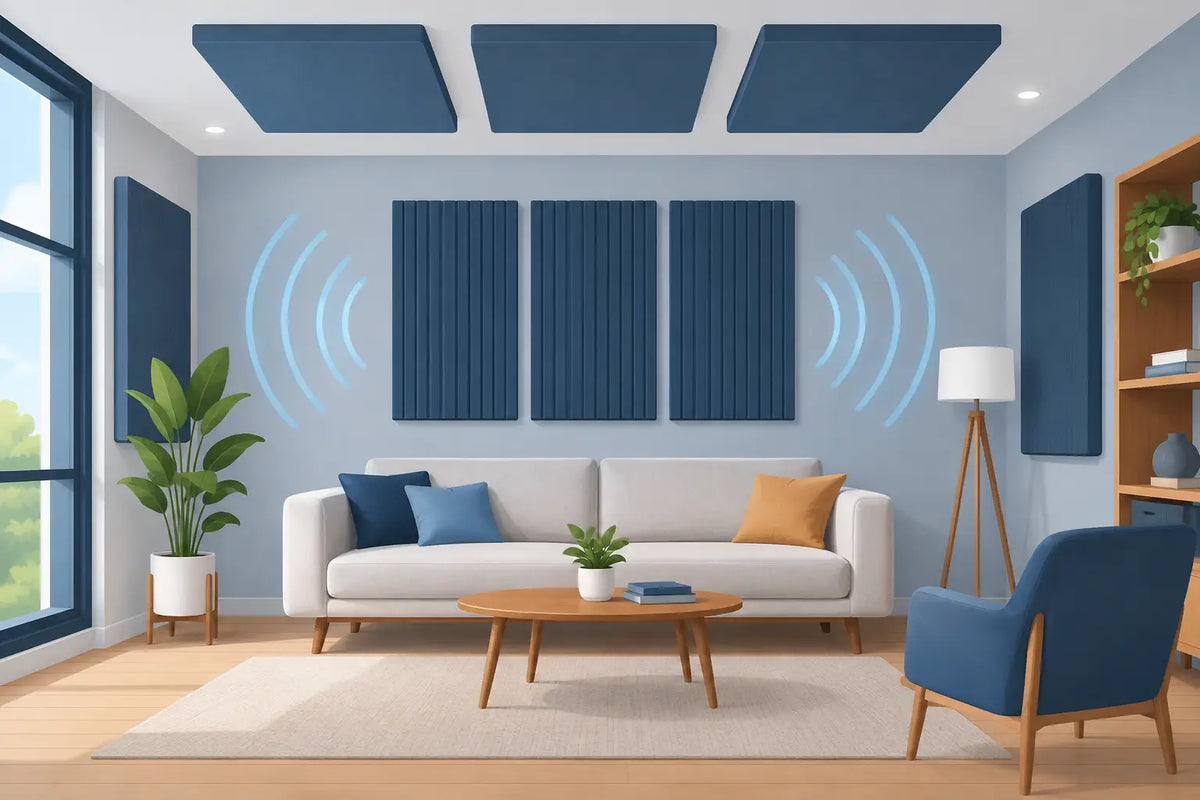
The side walls are common reflection points. A simple way to identify them is the mirror method: while you sit in the main listening seat, ask someone to move a mirror along each side wall. Wherever you can see a loudspeaker in the mirror is a likely first-reflection point. Acoustic panels, fabric wall systems or, in some rooms, carefully positioned shelving can help here.
The ceiling and floor also matter. A rug addresses part of the floor reflection; a ceiling treatment may be valuable in a dedicated cinema, especially where the ceiling is low and speakers are close to the seating area. In a family living room, discreet fabric panels or design-led acoustic finishes can provide a more practical answer than turning the space into a recording booth.
Take bass seriously, especially in smaller rooms
Low frequencies are usually the hardest part of how to improve room acoustics because bass behaves differently from treble. It has long wavelengths, travels through much of the room and is far less affected by lightweight foam. The familiar foam tiles sold for home studios may tame a little high-frequency reflection, but they will not resolve a 40Hz boom.
Start with subwoofer position. Do not assume the front corner is automatically best. Corners increase output, but can also exaggerate room modes. In a home cinema, two properly positioned subwoofers can often produce more even bass across several seats than one larger unit. This is particularly valuable for families, where the best seat should not be the only seat with convincing impact.
Purpose-built bass traps, usually placed in corners or wall-ceiling junctions, can help in dedicated rooms. They need meaningful depth and careful placement to work effectively. For a premium listening room or cinema, measurement and calibration are well worth considering. Systems such as advanced room correction can improve the final response, but they work best after sensible loudspeaker placement and physical acoustic treatment. Digital correction is a finishing tool, not a substitute for addressing the room.
Choose treatments to suit the room and its use
The right treatment depends on whether the room is a relaxed lounge, a two-channel listening space or a dedicated cinema. A lounge may benefit from rugs, curtains and a small number of attractive wall panels. A dedicated cinema can accommodate deeper bass control, acoustic walls and a treated ceiling, allowing reference-level playback without the room becoming overbearing.
There are three broad treatment approaches. Absorption reduces reflected energy and is useful at first-reflection points. Diffusion scatters sound in different directions, preserving a sense of openness without pronounced echoes. Bass trapping targets low-frequency build-up. Most high-performing rooms use a considered combination rather than relying on one treatment everywhere.
Aesthetics deserve equal attention. Acoustic fabric walls can conceal treatment, loudspeakers, cabling and even doors while giving a cinema a refined, purposeful finish. In a music room, panels can be matched to the décor or integrated as artwork. The best installation should feel like part of the home, not an afterthought.
Measure when the room deserves precision
Your ears should make the final decision, but measurement removes much of the guesswork. A calibrated microphone and room-analysis software can show bass peaks, nulls and decay times that are difficult to identify reliably by listening alone. This is especially useful when integrating subwoofers, multiple seating positions or sophisticated AV processing.
Measurements need interpreting in context. Chasing a perfectly flat graph can lead to an unnatural result, particularly if excessive correction removes the natural warmth or scale of a room. A good calibration balances objective data with the way real music and films feel. The target is controlled, engaging sound, not a chart to admire.
For complex projects, professional design and calibration can prevent costly trial and error. Yorkshire AV can assess the relationship between room, loudspeakers, subwoofers and seating before recommending treatments that suit both the performance target and the way the space needs to look and work.
Give changes time and make them one at a time
Move one variable, then listen again. If you reposition speakers, resist the temptation to alter toe-in, subwoofer level and room correction on the same afternoon. You will not know which change helped. Use a small group of familiar recordings and film scenes, and listen at realistic levels rather than only during a quick demonstration.
A room with well-managed acoustics does not announce itself. Instead, voices become more intelligible, bass gains shape rather than sheer quantity, and the soundstage opens without becoming artificially bright. When that happens, you stop listening to the room and start listening to the performance - exactly where your attention belongs.


Share:
What Is Trinnov Calibration and Why It Matters
Fabric Acoustic Wall Panels for Better Sound