A premium cinema system can have exceptional loudspeakers, serious amplification and a beautifully engineered processor, yet still sound less convincing than it should. The reason is usually the room. What is Trinnov calibration? It is the detailed measurement and optimisation process used by Trinnov processors to make your loudspeakers, subwoofers and listening room work together as one coherent cinema.
It is not a generic automatic set-up routine that runs for five minutes and leaves every decision to software. Done properly, Trinnov calibration is a considered part of system design. It measures what is actually arriving at the listening position, then gives an experienced installer the tools to correct timing, level, phase, frequency response and speaker positioning issues with remarkable precision.
The result should not be sound that merely feels louder or more processed. It should be a more believable performance: dialogue locked firmly to the screen, effects travelling cleanly around the room, bass with weight and control, and music that retains its scale and texture.
Below is the Trinnov Altitude 16

What is Trinnov calibration designed to solve?
Every room has an acoustic signature. Hard surfaces reflect sound, dimensions create bass resonances, seating positions alter what you hear, and even a carefully selected speaker package can be compromised by placement restrictions. In a family lounge, speakers may need to work around furniture and doors. In a dedicated cinema, multiple rows of seating, acoustic treatment and several subwoofers add another layer of complexity.
Trinnov’s Optimizer technology is designed to analyse these real-world conditions rather than assume an ideal room. It identifies how each speaker behaves in relation to the listening area and to every other speaker. The processor can then apply highly detailed corrections, helping the system reproduce a soundtrack or concert recording with greater accuracy and consistency.
This matters most in immersive home cinema. With Dolby Atmos, DTS:X or Auro-3D, the sense of space relies on precise timing and stable placement. If a surround or height speaker is slightly late, incorrectly levelled or tonally different from the rest, an object moving through the soundfield can lose its direction. Trinnov aims to keep the whole array working as a single, convincing acoustic picture.
Click here for Calibration Information at Yorkshire AV
The difference is the measurement microphone
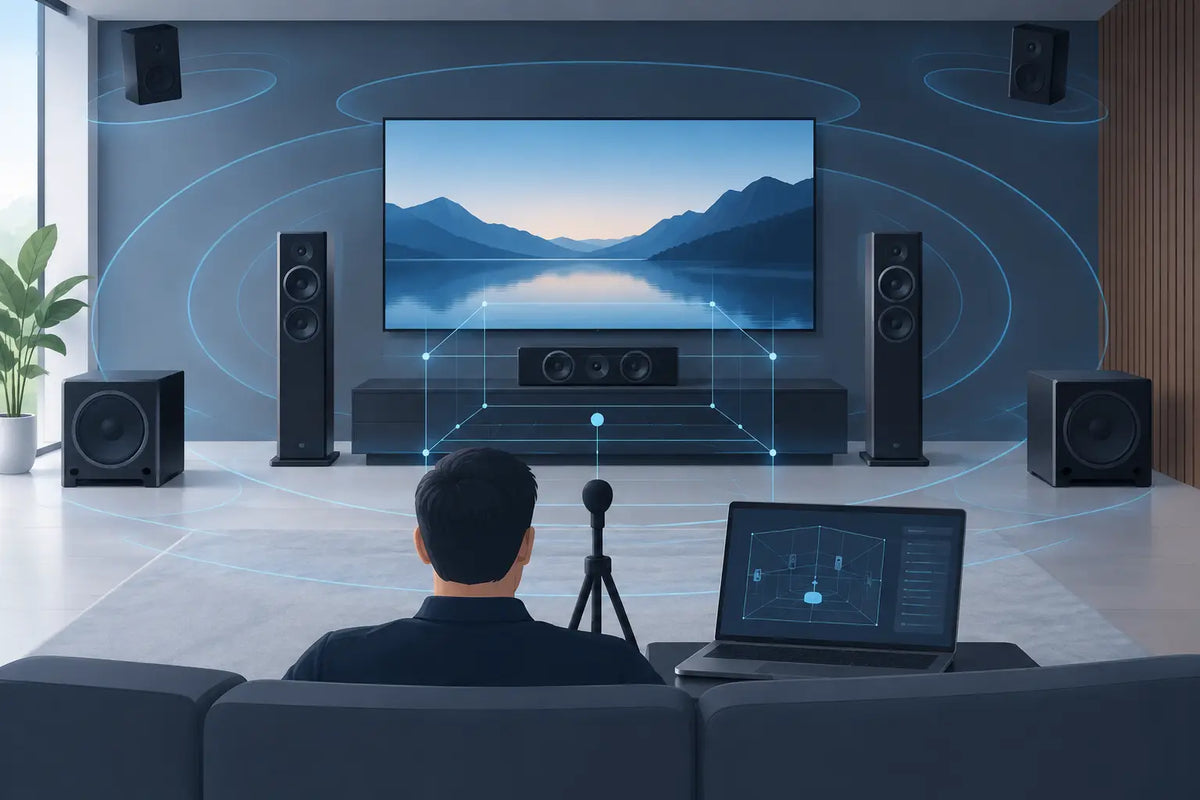
A Trinnov calibration begins with the company’s distinctive 3D measurement microphone. Unlike a conventional single-capsule microphone, it uses four capsules arranged in a known geometry. This allows the processor to measure not only the response of a speaker, but also its position in three-dimensional space.
The system sends test signals through each channel and records how they arrive at the microphone. From this data, it can establish speaker distances, levels, arrival times, phase behaviour and angular position. It also reveals the room’s influence, particularly where reflections and bass modes are affecting the response.
Several measurements are normally taken around the main listening position rather than relying on one point in space. That is important because ears do not occupy a fixed pin-head position, and most cinemas are intended for more than one viewer. The exact approach depends on the room, seating layout and priorities. A single reference chair can be optimised differently from a sofa used by the whole family.
What happens during a professional Trinnov calibration?
The process starts before the microphone is switched on. Speaker locations, seating positions, screen height, room construction and equipment choices all influence the final result. A good calibration cannot compensate for every fundamental design issue, so practical placement and acoustic treatment should be considered first.
Once the system is installed, each loudspeaker and subwoofer is measured. The Trinnov processor assesses timing, output level and response, while the installer checks that the measured results make sense in the room. A miswired speaker, a subwoofer set to the wrong mode or an unsuitable crossover setting can be identified here, before it becomes a frustrating listening problem.
The Optimizer then creates correction filters for the individual channels. These can address broad tonal imbalance, timing differences and problematic resonances. It also aligns the subwoofers with the main speakers, which is one of the most valuable parts of a high-performance cinema calibration. When bass management is properly integrated, low frequencies are more even, punchier and less likely to overwhelm dialogue or musical detail.
Trinnov can also use its Remapping capability on compatible systems. This helps preserve the intended location of immersive audio objects when speaker positions cannot exactly match an ideal layout. It is particularly useful where architecture dictates compromises - perhaps a rear speaker must sit slightly wider than planned, or ceiling speakers cannot be placed at precisely the recommended angle.
The final stage is not simply pressing save. An experienced calibrator listens. Measurements are essential, but the target curve and final voicing should suit the system and its owner. A cinema designed principally for blockbuster films may benefit from a different balance to a room that spends equal time playing two-channel music, live concerts and television.
Calibration is not the same as acoustic treatment
It is tempting to think that sophisticated room correction makes acoustic treatment unnecessary. It does not. Trinnov can make extremely effective adjustments to what the loudspeakers deliver, but it cannot remove the physical effects of a large glass wall, a bare floor or a low-frequency resonance that hangs in the room long after a bass note has stopped.
Acoustic panels, bass trapping, fabric walls, rugs and considered furnishing choices manage the sound energy within the room itself. Calibration then refines the loudspeaker system around that improved acoustic foundation. The two approaches are complementary.
There is a trade-off to consider. Over-correcting a room can make a system sound overly controlled or less natural, particularly if correction is pushed too high in frequency or used to chase every small measurement variation. This is where Trinnov’s flexibility and professional judgement matter. The objective is not a graph that looks impressive. It is a system that sounds open, dynamic and emotionally involving.
Why subwoofers benefit so much
Low frequencies are where rooms tend to have the greatest influence. A subwoofer may sound powerful in one chair and thin or boomy only half a metre away. Adding more subwoofers can improve consistency, but only when their placement, phase and timing are properly managed.
Trinnov calibration can measure and integrate multiple subwoofers as part of the wider speaker system. It helps them work together rather than compete, reducing obvious peaks and dips across the listening area. The audible benefit is not simply more bass. It is bass that starts and stops with greater authority: a kick drum has definition, an orchestral crescendo builds without muddiness, and a film soundtrack gains the physical impact it was mixed to have.
For a dedicated cinema with several subwoofers, this level of control can be transformative. For a stylish living-room installation with a discreet subwoofer, it can be equally useful because it helps deliver satisfying scale without the familiar boom that makes people reach for the volume control.
What will you hear after Trinnov calibration?
The changes vary by room, but listeners often notice the centre channel first. Dialogue becomes clearer and more firmly anchored, even at lower listening levels. Surround effects become less like separate speakers calling for attention and more like a continuous soundfield extending beyond the walls.
There is usually a stronger sense of depth too. Subtle details - rain in the distance, the decay of a piano note, an audience response at a live performance - are easier to follow because the system is no longer masking them with timing errors or uneven bass. With well-matched loudspeakers, the presentation can feel effortless rather than artificially sharpened.
That said, calibration cannot turn unsuitable equipment into a reference system, nor can it fully overcome severe placement limitations. Speaker quality, amplifier headroom, room proportions and acoustic treatment still matter. Trinnov is most compelling when it is part of a properly planned system, from a focused 5.1.4 installation to a full THX Dominus-capable cinema.
Is Trinnov calibration worth it?
For a modest television-and-soundbar set-up, no. The investment and capability would be disproportionate. But for a serious home cinema or a high-channel-count entertainment room, it can be one of the most meaningful upgrades available because it improves the performance of every speaker you already own.
It is especially worthwhile when the system includes multiple subwoofers, immersive audio, challenging room acoustics or architectural compromises. It also offers long-term value: if seating, speakers or room furnishings change, the system can be re-measured and refined rather than left to drift away from its original performance.
At Yorkshire AV, the best way to understand the effect is to hear a properly configured Trinnov cinema rather than judge it from a specification sheet. A great calibration should not announce itself as a feature. It should leave you absorbed in the film, the performance and the feeling that the room has disappeared.


Share:
AV Processor vs Receiver: Which Suits Your Cinema?
How to Improve Room Acoustics Properly