
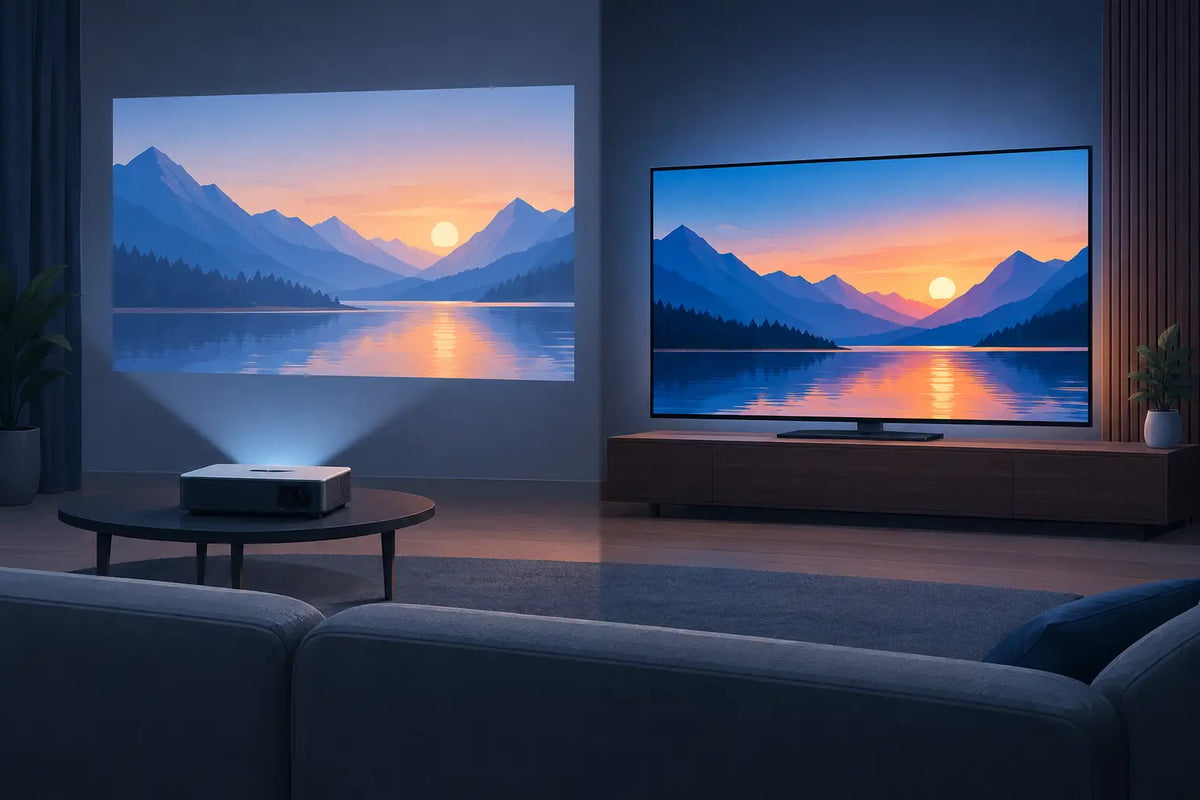
A 77-inch OLED can look astonishing in a bright lounge. A properly specified projector on a 120-inch screen can make the same film feel like an event. That is the real question behind projector versus OLED: not which technology wins a specification sheet, but which one gives your room, your viewing habits and your system the more convincing cinema experience.
For some homes, an OLED is the obvious answer: beautifully simple, immensely capable and ready for everyday television. For others, particularly where films, sport and games are enjoyed with family or friends, the scale of projection changes the emotional impact completely. The right choice depends on far more than resolution.
Projector versus OLED: start with the screen size
Screen size is where projection has an advantage no television can casually overcome. Even premium OLED models become expensive quickly as sizes rise, while a projector and quality screen can deliver a 100-inch, 120-inch or larger image without turning the display into the dominant object in the room.
That extra scale is not just about spectacle. At a sensible seating distance, a large projected image fills more of your field of vision. Wide landscapes feel expansive, close-ups have greater presence and a well-mastered 4K disc gains the sense of depth that home cinema enthusiasts chase. Add capable surround sound or a properly calibrated immersive audio system and the room starts to disappear.
OLED remains compelling where space is limited. In a snug, kitchen-living area or media room where seating is close to the display, a 65- or 77-inch panel can feel generously cinematic. It also suits those who want a screen that performs brilliantly for a ten-minute news bulletin, an afternoon of sport and a late-night film without changing the room around it.
The most useful exercise is to measure the wall and your main seating position. Then imagine the image, rather than simply measuring the panel. A screen that looks enormous in a shop may feel modest once it is across a larger room.
Contrast, black levels and HDR
OLED’s reputation is built on its black levels, and rightly so. Because each pixel can switch off independently, an OLED can place a bright street lamp against a genuinely black night sky with exceptional precision. It also offers excellent viewing angles, meaning people spread across a sofa are not penalised with a washed-out image.
For mixed-use rooms and evening viewing, this makes OLED wonderfully satisfying. Shadow detail is clear, colours are rich without needing to be overcooked, and HDR highlights can have real intensity. Modern OLED sets also handle motion extremely well, making them excellent for sport and gaming as well as films.
A projector cannot create pixel-level black in the same way. Its performance depends on the projector’s native contrast, dynamic light control, the screen material and, crucially, the room. Light reflecting from pale walls, ceilings and furnishings returns to the screen and lifts the black floor. This is why a projector that looks superb in a dedicated demonstration room can disappoint when placed in a white-box lounge with bright downlights.
That does not mean projectors are poor at cinematic contrast. Far from it. A high-quality projector in a dark, well-treated room can produce beautifully natural blacks, nuanced shadow detail and an effortless, film-like image. But it asks more of the room. Darker finishes near the screen, controlled lighting and appropriate screen selection matter as much as the projector itself.
HDR is another area where context matters. OLED generally delivers more immediately punchy HDR because its highlights are brighter relative to its blacks. Projection tends to present HDR with a gentler, more natural character, particularly on a large image. A good home cinema system is calibrated to preserve detail and balance rather than chase showroom brightness, and that can look remarkably convincing over two hours of film.
Daylight, lamps and everyday flexibility
If the room has large windows and is used throughout the day, OLED is usually the simpler, stronger choice. It has the brightness to hold its own against ambient light and needs no screen to look coherent. Switch it on, select a source and it is ready.
Projection can work in a living room, but the installation needs more thought. Blackout blinds, curtains or automated shading can transform the result. A screen with carefully chosen gain or ambient-light-rejecting properties may help in certain spaces, though these are not universal fixes. Some such screens can narrow viewing angles or alter the image character, so they should be selected for the room rather than added as an afterthought.
Think honestly about how you watch. If television is on while cooking, children are playing nearby and sunlight is streaming across the floor, OLED offers welcome practicality. If your best viewing happens after dark, when the lights dim and everyone settles in for a film, projection becomes a far more attractive proposition.
The image is only half the cinema
A large television has speakers built in, but even an expensive panel deserves better audio if film is a priority. Dialogue, effects and music all gain body and clarity from a separate system. A compact soundbar can be a meaningful improvement, but a properly designed AV system with separate speakers and subwoofers is in another league.
Projector installations often encourage this fuller approach because the screen becomes the centrepiece of a dedicated setup. An acoustically transparent screen can place the centre speaker behind the image, just as it would be in a commercial cinema. Acoustic walls can control reflections and hide speakers, while careful subwoofer placement brings impact without turning bass into a blunt thump.
This is where a modestly specified projector in a well-designed room can be more involving than a technically superior display with compromised sound. The crack of a rally car, the weight of an orchestral score and a whispered line of dialogue all contribute to the picture you remember.
Installation, design and ownership
OLED is the least demanding route. Wall-mount it or place it on furniture, connect your sources and you are most of the way there. Cable management, ventilation and speaker positioning still deserve attention, but the display itself is straightforward.
A projector requires decisions around throw distance, lens position, mounting height, cabling and screen size. Short-throw models can reduce the distance required, although they bring their own screen and furniture considerations. Traditional long-throw projectors are often neater in a purpose-designed room, mounted discreetly on the ceiling or housed within joinery.
Do not overlook operational noise. Better projectors are quiet enough to disappear during a film, but their fan noise, especially at higher brightness settings, should be considered in smaller rooms. There is also maintenance. Lamp-based models eventually need replacement lamps; laser projectors offer much longer light-source life and quicker start-up, though usually at a higher initial cost.
OLED ownership has its own considerations. Modern panels have strong protections against image retention, but anyone planning to leave static news tickers, channel logos or game interfaces on screen for many hours each day should use the panel’s care settings sensibly. For normal varied viewing, this is rarely a practical concern.
So, which should you choose?
Choose OLED if you want outstanding contrast, strong daytime performance, excellent gaming credentials and minimal installation complexity. It is the natural fit for a bright, multi-purpose room where the display needs to look superb at any hour.
Choose a projector if you want the scale and atmosphere of genuine home cinema, have control over lighting and are prepared to design the room around the experience. It is particularly rewarding for film lovers who value a 100-inch-plus image, shared viewing and a screen that can disappear when not in use.
There is also a compelling middle ground: an OLED for everyday use in the main living space, and a projector-led system for a dedicated cinema room, loft conversion or carefully planned extension. They do different jobs exceptionally well.
The specifications can only take you so far. Seeing different screen sizes, black-level performance and projector brightness in a controlled setting makes the decision far clearer. At Yorkshire AV, a demonstration can turn an abstract comparison into a room-specific plan - because the best display is the one that makes you look forward to pressing play.

Share:
Vinyl Record Cleaning Guide for Better Sound