
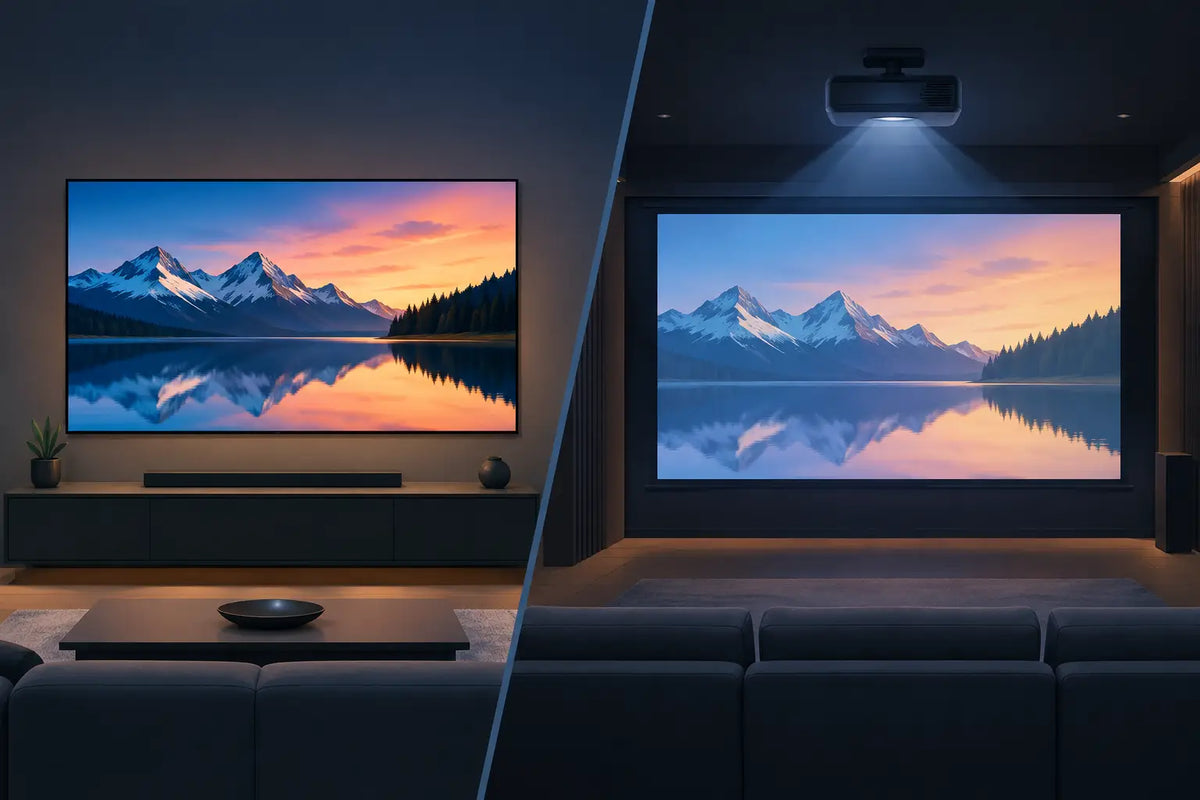
A 77-inch OLED can make a film look startlingly immediate: pin-sharp subtitles, inky night scenes and bright highlights that hold their punch with the curtains open. A projector, meanwhile, can turn a carefully planned room into something that feels closer to a private picture house. The OLED vs projector decision is not really about which technology is universally best. It is about the experience you want when the lights go down, and the room you have to work with.
For a main family room, an OLED is often the easy performance win. For a dedicated cinema room, a properly specified projector and screen can deliver the scale that makes a blockbuster, concert film or big sporting occasion feel genuinely special. The best choice balances picture quality, screen size, ambient light, viewing distance and the wider sound system around it.
OLED vs projector: start with screen size
Screen size changes everything. It determines how involved you feel with the image, how visible fine detail becomes and how well the picture matches the scale of a serious surround-sound system.
OLED televisions are now available at imposing sizes, with 77, 83 and larger models capable of delivering a superb cinema experience in a living room. At sensible viewing distances, a large OLED is richly engaging without dominating every inch of the space. Its slim form can also look remarkably elegant on a wall, particularly when paired with discreet cable management and a carefully chosen soundbar or speaker system.
Projectors take over when the brief calls for 100 inches and beyond. At that scale, a wide CinemaScope image has a sense of occasion that even a very large television cannot quite reproduce. A 120-inch screen can make the difference between watching a film and being absorbed by it, especially from a seating position that lets the image fill a generous part of your field of view.
There is, however, a practical limit. Bigger is not automatically better if the projector, screen and viewing distance are poorly matched. A large image with weak contrast, visible noise or overly close seating can become tiring. The screen size should be designed around the room rather than selected from a showroom measurement alone.
Where OLED has the picture-quality advantage
OLED remains exceptionally compelling because every pixel can control its own light output. In a dark scene, neighbouring bright and dark details can sit together without the blooming or grey haze that can affect other display technologies. Shadow detail in a thriller, the glow of city lights at night and the texture of a dark suit are all rendered with impressive precision.
It also has everyday strengths that matter more than specifications suggest. OLED televisions are bright enough for most lounges, cope well with daytime viewing and require no warm-up, alignment or lamp considerations. Switch on the television and the image is immediately consistent. For households where the screen is used for news, gaming, streaming and films throughout the day, that simplicity is valuable.
Modern OLED models offer excellent 4K clarity, wide viewing angles and strong HDR performance. They are particularly effective when seats are spread across a broad sofa arrangement, as viewers off to the side still see a convincing image. If your room has pale walls, windows or regular lighting, an OLED's contrast and brightness can be easier to enjoy than a conventional projection system.
The trade-off is immersion through scale. Even an 83-inch OLED may feel modest in a large dedicated cinema room with two or three rows of seating. There is also the visual reality of a glossy black panel mounted on the wall. It can be beautifully minimal, but it does not disappear in the way a recessed projection screen can.
Why a projector still feels like cinema
A good projector is not simply a television made bigger. The reflected-light image has a different character: softer on the eye, more relaxed over a long film and naturally expansive. Combined with a quality screen, it can create that familiar cinema sensation of image scale without a bright panel becoming the focal point of the room.
In a dedicated space with controlled light, projection comes into its own. Dark wall finishes, blackout blinds, acoustic treatments and a dark ceiling all preserve contrast by stopping stray light from washing across the screen. These details can be as influential as the projector model itself. A premium projector in a white, sunlit room will rarely show what it is capable of.
Projectors also offer flexibility for those planning a room from scratch. A motorised screen can lower for film night and vanish afterwards. An acoustically transparent screen can place the front left, centre and right speakers behind the image, just as they are in a commercial cinema. Dialogue then comes from the actors' position on screen rather than from below it, which is a major step forward for a truly convincing installation.
The compromise is that projection demands more of the room and the installation. You need to consider throw distance, lens shift, ceiling position, ventilation, cabling and screen material. Fan noise must be kept low at the seating position, and any projector's light source will gradually age. These are manageable considerations, but they deserve proper planning.
Ambient light and HDR: the detail many buyers miss
If you regularly watch football on a Saturday afternoon or catch up on television with lamps on, OLED has the advantage. Its higher perceived brightness and direct-emissive image cut through everyday room light more effectively. Reflections can still be visible on a glossy screen, but the picture generally retains more impact.
A projector can work in a multi-purpose room, particularly with an ambient-light-rejecting screen, but this is not a magic fix. Such screens can be highly effective when matched to the right projector and room layout, yet they introduce their own viewing-angle and placement considerations. The best result still starts with controlling the light that reaches the screen.
HDR is another area where comparisons can become misleading. OLED can produce bright, precise highlights while maintaining deep blacks, so HDR material often looks remarkably vivid. Projectors usually have less peak brightness, but the larger image changes the perceived impact. A well-calibrated projector in a dark room can deliver beautifully nuanced HDR with a more cinematic, less television-like presentation. The goal is not necessarily the brightest highlight. It is believable contrast across the entire image.
Do not separate the picture from the sound
A 120-inch projected image partnered with a modest soundbar is rarely satisfying. Equally, a large OLED with a properly integrated 5.1.4 or 7.2.4 speaker system can be an electrifying film setup. The display choice should sit within a complete plan for speakers, subwoofers, AV processing, source equipment and room acoustics.
For projector-led cinema rooms, the screen can shape the entire speaker layout. An acoustically transparent screen makes it possible to hide matching front speakers behind the image, while in-wall or fabric-wall treatments keep the room visually calm. For an OLED installation, a high-quality centre speaker below the screen, with left and right speakers positioned correctly, can produce wonderfully focused dialogue and a broad soundstage.
Bass also matters. Film soundtracks rely on controlled low frequencies as much as dramatic effects. The difference between one subwoofer placed where it fits and a properly integrated multi-subwoofer design can be enormous, bringing weight to a soundtrack without the boom that makes dialogue muddy.
Choosing for a lounge, media room or dedicated cinema
For a typical lounge, choose OLED if versatility is the priority. It is the sensible premium choice for mixed daytime and evening use, especially where a clean wall-mounted installation and minimal fuss matter. A 77-inch or larger model can be astonishingly capable when paired with serious audio.
For a media room that is used mostly after dark, the decision is more finely balanced. A very large OLED offers excellent convenience and class-leading contrast, while a projector begins to make sense if the room can accommodate a 100-inch-plus screen and you are willing to manage light levels. Here, viewing distance is often decisive.
For a purpose-built cinema room, projection deserves serious consideration. Once the room includes blackout control, a suitable screen, considered seating and dedicated surround sound, the scale and integration available from a projector are difficult to beat. This is where design choices such as acoustic walls, concealed equipment and calibrated audio become part of the pleasure rather than an afterthought.
See the differences in the right conditions
Specifications cannot tell you how a display will feel at your preferred screen size, from your normal seating distance, with real film material. Nor can they show how much a room's walls, lighting and speaker placement influence the final result. At Yorkshire AV, a demonstration and conversation about the room can turn a broad OLED versus projector question into a confident system design.
Think first about the film nights you want to have. If it is effortless, brilliant picture quality for every kind of viewing, an OLED may be exactly right. If it is the hush before the opening titles on a 120-inch screen, with the soundtrack rising around you, give the room and the projector the attention that experience deserves.

Share:
Isotek Mains Cleaning: What You Can Hear