
The moment a cartridge is holding your records back, it is usually obvious: vocals sit behind the loudspeakers rather than between them, cymbals turn splashy, and familiar bass lines lose shape. A well-chosen cartridge can bring startling focus, colour and energy to a turntable you already enjoy. This turntable cartridge upgrade guide will help you spend where it matters, while avoiding a mismatch that leaves a fine cartridge performing below its best.
Turntable cartridge upgrade guide: start with the system
A cartridge does not work in isolation. It is the first link in a chain that includes the tonearm, turntable, phono stage, amplifier, loudspeakers and, crucially, your room. Fitting a more expensive model can reveal low-level detail, wider dynamics and more natural instrumental texture. It can also expose limitations elsewhere, such as a noisy phono input, poorly positioned loudspeakers or a turntable sitting on an unstable cabinet.
Start by asking what you want to change. If your current sound is thin or hard, a cartridge known for a fuller, more forgiving presentation may be the answer. If the system is warm and relaxed but lacking insight, a more precise stylus profile and lower moving mass may make far more sense. This is not simply a race towards more detail. The right result is a system that makes you want to play another side.
Before choosing anything, check the make and model of your turntable and tonearm, the cartridge currently fitted, and whether you use a separate phono stage or the phono input on an amplifier. These details establish what will fit and what will work electrically.
Check compatibility before chasing specifications
Most moving-magnet cartridges use the familiar half-inch mounting arrangement, but not every tonearm offers the same adjustment. Some designs have limited or no provision for vertical tracking angle adjustment, while others use their own mounting format. Cartridge body height matters because a tall cartridge can alter the angle at which the arm meets the record. It will still play, but it may not extract the performance you have paid for.
The other mechanical consideration is the relationship between tonearm effective mass and cartridge compliance. Compliance describes how readily the cantilever suspension moves. In broad terms, a high-compliance cartridge favours a lighter arm, while a lower-compliance moving-coil design often suits a medium-mass or heavier arm. Together they create an arm-and-cartridge resonance frequency. A sensible target is generally around 8-12Hz: low enough to sit below musical bass, but high enough to avoid being troubled by record warp and footfall.
You do not need to calculate every figure to make a successful choice, but this is why a recommendation based solely on price is unreliable. A cartridge that sings in one turntable can sound unsettled in another.
Moving magnet or moving coil?
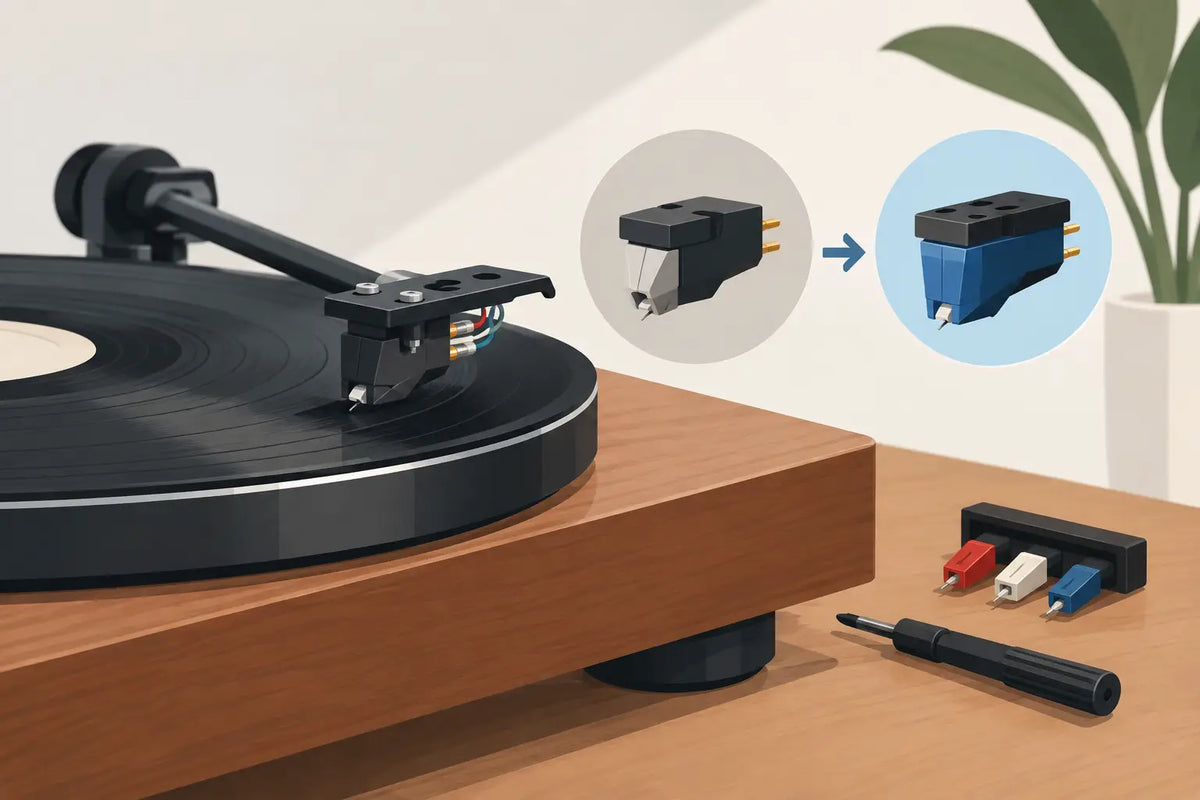
Moving-magnet, or MM, cartridges remain a superb choice for many systems. They offer strong output, work with standard MM phono inputs, and often allow the stylus assembly to be replaced separately once worn. Modern MM designs can deliver excellent tracking, punch and openness without making the rest of the system difficult to accommodate.
Moving-coil, or MC, cartridges can offer a greater sense of delicacy, space and transient speed, particularly in a resolving system. Their lower output, however, requires an MC-capable phono stage or a suitable step-up transformer. Gain and loading need attention, and the stylus is usually not user-replaceable. An MC upgrade is best viewed as a system decision rather than a cartridge-only purchase.
Do not overlook the phono stage. An MM cartridge is affected by capacitance from the cable and input, which can subtly alter treble balance. An MC cartridge needs enough clean gain and an appropriate loading option. If your phono stage has fixed settings, choose a cartridge that suits them rather than assuming every model will be equally happy.
Choose a stylus profile for the way you listen
The stylus shape has a major influence on tracking and information retrieval. A bonded elliptical stylus is a capable, sensible step up from a basic conical type, offering clearer high frequencies and improved inner-groove performance. It is often an excellent match for a well-sorted entry-level or mid-price turntable.
Fine-line, MicroLine and similar advanced profiles reach further into the record groove. They can reduce distortion towards the end of a side and uncover remarkable detail from clean, well-pressed records. They also demand more careful alignment. With worn records, poor setup or a dusty collection, their honesty can be less flattering.
Shibata profiles are another compelling option, often valued for their extended frequency response, image depth and authority. There is no universal winner. Your records, setup standards and preferred musical balance matter more than a stylus profile’s reputation on paper.
Set a sensible budget for the whole upgrade
It is tempting to spend the entire budget on the cartridge. Yet a new cartridge fitted with a tired belt, worn bearings, an unsuitable mat or a basic phono input may not deliver the scale of improvement you expect. Leave room for proper installation and, where needed, a better phono stage or support solution.
As a practical rule, the cartridge should suit the level of the turntable and the rest of the hi-fi. A modest deck with a carefully selected elliptical MM cartridge, accurately aligned, can be deeply satisfying. A higher-tier turntable with a refined arm and adjustable phono stage will justify more ambitious fine-line MM or MC options. The best value is not the lowest price or the highest specification. It is the point where every component is contributing rather than one doing all the work.
Installation is part of the upgrade
A cartridge is a precision instrument, and setup is not a cosmetic finishing touch. Alignment affects channel balance, tracking distortion, stereo image and record wear. Tracking force, anti-skate and arm height must be set accurately using the cartridge manufacturer’s guidance and, ideally, appropriate measuring tools.
Take particular care with the delicate cantilever. Work in good light, protect the stylus guard where possible, and do not force cartridge tags onto pins. If the headshell leads are stiff or corroded, deal with that before installation. A loose connection can lead to hum, intermittent sound or channel imbalance that is wrongly blamed on the cartridge.
Once fitted, allow time for listening and, where relevant, running in. The suspension of a new cartridge can settle over the first several hours. Do not constantly alter settings in search of an instant transformation. Set it correctly, keep the records and stylus clean, then listen across familiar acoustic, vocal and rhythm-led recordings.
If you hear sibilance, distortion near the inner grooves, uneven channels or a loss of bass control, stop and revisit setup. These are not quirks to tolerate. They are usually useful clues that alignment, tracking force, arm compatibility or phono-stage matching needs attention.
When a replacement stylus is the smarter choice
Not every apparent cartridge upgrade needs a complete new body. If you are happy with the character of an MM cartridge and it accepts a higher-grade replacement stylus, that can be an intelligent route to better tracking and resolution. It also keeps the electrical match with your phono stage intact.
Conversely, a stylus replacement will not solve a cartridge body that has reached the ceiling of what your system can reveal. If you have upgraded loudspeakers, amplification and phono stage since buying the turntable, moving to a more capable cartridge may be the change that finally brings those improvements together.
A cartridge is one of the few hi-fi upgrades that touches the music at its source. That makes careful matching worthwhile. Bring along a few records you know intimately, listen for timing and tone as much as detail, and trust the option that makes your collection feel newly alive. At Yorkshire AV, a proper audition can turn a technical decision into the simple pleasure of hearing your favourite album properly again.



Share:
Choosing the Best Amplifier for Vinyl Playback
What Is a Phono Stage? The Vinyl Signal Explained