
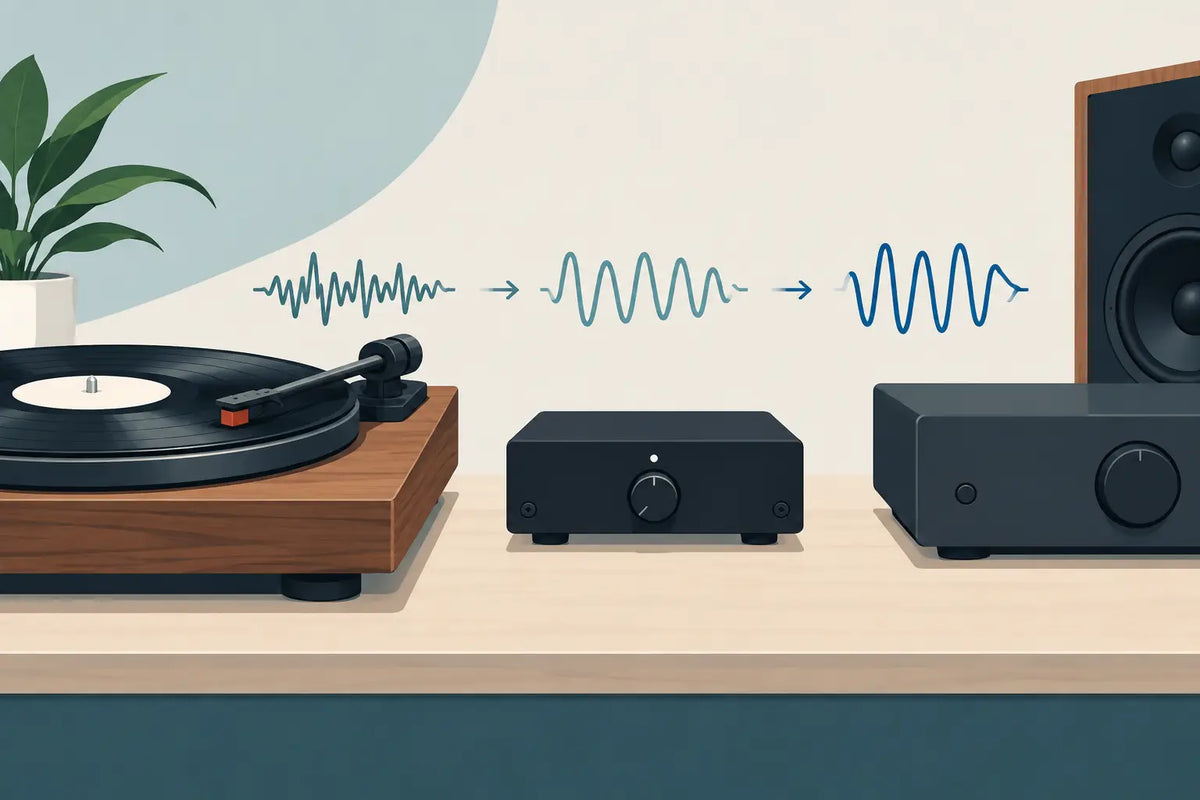
A turntable cartridge produces an extraordinarily small electrical signal. Feed that signal straight into a conventional amplifier input and the result will be faint, thin and lacking bass. So, what is a phono stage? It is the vital component that brings your vinyl signal up to line level, restores its tonal balance and lets the character of your records reach the rest of your hi-fi system.
For anyone building a serious vinyl system, the phono stage is not a background detail. It has a direct bearing on noise, scale, timing, tonal colour and the sense that a singer or instrument has entered the room. A good turntable and cartridge need a suitably capable phono stage to show what they can really do.
What is a phono stage and what does it do?
A phono stage, also called a phono preamplifier, sits between your turntable and your amplifier. Its first job is gain: increasing the tiny output from the cartridge to the standard level expected by an amplifier's AUX, CD, line or streamer input.
Its second job is equally crucial. Vinyl records are cut using the RIAA equalisation curve. During mastering, bass is reduced and treble is boosted. This makes the groove easier to cut and helps reduce unwanted surface noise. The phono stage applies the reverse RIAA correction during playback, restoring bass weight, treble balance and the natural tonal shape of the recording.
Without this correction, records would sound noticeably bright, lightweight and rather strange. With it handled accurately, a well-set-up vinyl front end can sound wonderfully direct: a brushed cymbal has air rather than glare, a double bass has body and a familiar vocal takes on convincing presence.
Why a normal amplifier input will not work
Most modern integrated amplifiers provide line-level inputs. These are designed for sources such as streamers, CD players and DACs, which already send out a comparatively strong signal. A moving-magnet cartridge may output around 3 to 6 millivolts, while some moving-coil designs produce less than 0.5 millivolts.
That difference is immense. A phono stage must provide substantial amplification while keeping hiss, hum and distortion extremely low. It also has to preserve delicate musical information, including the decay around notes and the quiet spaces that give a recording atmosphere.
Some integrated amplifiers include a phono input. In that case, the phono stage is already built in, and your turntable connects to the dedicated input rather than an AUX or line input. If your amplifier does not have a phono input, an external phono stage is essential.
Moving magnet and moving coil cartridges
The cartridge fitted to your turntable determines the sort of phono stage settings you need. The two most common types are moving magnet, usually shortened to MM, and moving coil, known as MC.
Moving magnet
MM cartridges are widely used because they offer strong output, excellent musical performance and, in many cases, a replaceable stylus. They generally need less gain than MC cartridges and are compatible with most built-in phono inputs.
A suitable MM phono stage also needs the right input capacitance and loading. These figures can sound rather technical, but they matter. The wrong capacitance can make some cartridges sound overly bright or dull, while the correct setting helps preserve an even, open presentation.
Moving coil
MC cartridges are often chosen for their speed, low moving mass and ability to reveal fine detail. They can produce exceptional depth, subtlety and dynamics, but they typically deliver a much lower output signal than an MM design. As a result, they need more gain and carefully chosen impedance loading.
Not every phono input supports MC cartridges. Some external stages offer switchable MM and MC modes, while more advanced models provide adjustable gain, capacitance and impedance. Those adjustments are worthwhile when the rest of the system is revealing enough to show the difference, but they should not become a distraction. A well-matched fixed-setting stage can be more satisfying than a complex unit set incorrectly.
Built-in or external phono stage?
A built-in phono stage is a sensible and tidy starting point. It reduces box count, simplifies installation and can deliver very enjoyable results with a good MM cartridge. Many quality integrated amplifiers include capable phono circuitry precisely because vinyl remains central to so many music collections.
An external phono stage has more room for dedicated power regulation, higher-quality components and improved isolation from the electrical noise generated inside an amplifier. It may also offer the flexibility to accommodate future cartridge upgrades. That can translate into lower background noise, wider dynamics, firmer bass and more convincing stereo imaging.
The answer depends on the system. If you have an entry-level turntable and a modest integrated amplifier, spending heavily on a standalone phono stage may unbalance the system. If you own a carefully set-up turntable with a quality cartridge, however, the phono stage can be one of the most rewarding upgrades available.
Matching a phono stage to your system
The best phono stage is not necessarily the one with the highest price or the longest specification sheet. It needs to suit the cartridge, amplifier, loudspeakers and your own listening priorities.
Start with cartridge compatibility. Check whether your cartridge is MM, high-output MC or low-output MC, then confirm that the phono stage offers the required gain and loading range. A low-output MC cartridge paired with insufficient gain can sound restrained and lifeless; excessive gain may bring unwanted noise and make volume control awkward.
Next, consider the overall character of your system. Some phono stages favour warmth and tonal density, which can be especially appealing with older pressings and acoustic music. Others aim for speed, resolution and tight bass control. Neither approach is automatically better. The right choice depends on whether you value a fuller, relaxed presentation or maximum insight into recording detail.
Power supply quality also matters more than many expect. The phono signal is so small that electrical noise can become audible as hum, hiss or a slight greying of the soundstage. Better designs pay close attention to grounding, shielding and power regulation. Placement helps too: keep the phono stage and its cables away from mains transformers, Wi-Fi routers and power supplies where possible.
Do not overlook setup
A phono stage cannot compensate for a poorly set-up turntable. Cartridge alignment, tracking force, anti-skate, turntable levelling and clean records all shape the final result. Even the best phono preamplifier will reveal problems elsewhere in the chain.
Grounding is another common source of confusion. Many turntables have a separate earth wire, which should usually connect to the phono stage or amplifier's ground terminal. If you hear a persistent low hum, check this first, then inspect cable routing and the proximity of power leads. Do not assume that a more expensive phono stage is the solution to a basic setup issue.
There is also a practical distinction between a turntable with a built-in phono stage and one without. If the turntable's internal stage can be bypassed, you can add an external unit later. If it cannot, feeding its line-level output into another phono input will apply gain and RIAA equalisation twice, producing poor sound. Connect a built-in stage to a standard line input instead.
Hearing the difference for yourself
Phono stages are often judged by details that are difficult to capture in a specification: the quietness behind a piano note, the authority of a kick drum, the way a crowded arrangement stays organised when the music builds. These qualities become far easier to assess through a properly matched system than by reading figures alone.
At Yorkshire AV, a comparison can be arranged around the turntable, cartridge and amplifier you already own or plan to buy. Fancy a demo? No problem. Hearing a few sensible options through capable loudspeakers is often the quickest way to decide whether you need more flexibility, greater refinement or simply a better match.
If your records already make you stop what you are doing and listen, a thoughtfully chosen phono stage can bring you closer still. Give it the same care as your cartridge and loudspeakers, and those well-loved albums may reveal a surprising amount that has been waiting in the grooves.



Share:
Turntable Cartridge Upgrade Guide for Better Sound
Music Streamer Buying Guide for Better Sound